
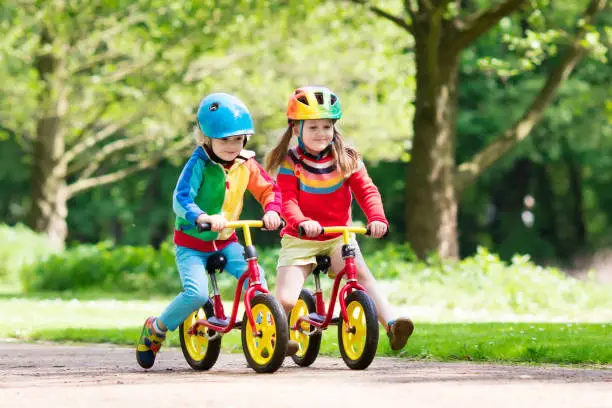
Remember those wobbly first bike rides? The scraped knees, frustrated tears, and that moment of panic when Dad let go of the seat? Yeah, that happens a lot. With proper training, you can avoid this. The first thing that you need is a balance bike.
These pedal-free bikes are changing the game for tiny riders everywhere. Traditional bike learning methods that often caused stress and frustration are now being replaced by more effective, child-friendly approaches.
According to the American Academy of Pediatrics (AAP), many children are developmentally ready to start using a balance bike as early as 18 months to 2 years old. And research suggests kids who use balance bikes often transition to pedal bikes nearly twice as fast compared to those who learn with training wheels.
Why balance bikes beat training wheels

Let’s talk about training wheels for a sec. We all had them, right? Those little stabilisers bolted to the back wheel that were supposed to teach us to ride, but mostly just taught us to lean awkwardly to one side.
The issue with training wheels is that they create a false sense of balance, which can delay a child’s ability to learn proper cycling skills. They teach kids to pedal, sure, but completely skip the most important part – actually balancing the bike. It’s like teaching someone to swim with floaties and then suddenly yanking them off in the deep end. Not cool.
Balance bikes flip the script entirely. Kids start by just walking the bike, then progress to those adorable little running glides where both feet are off the ground for a few seconds. They’re learning to balance before anything else. No bad habits to break later.
How to make bicycle learning fun?

The best part about balance bikes is that kids don’t think they’re “learning” anything – they’re just playing!
Want to level up the fun factor? Transform your driveway into a simple obstacle course to help your child practice balance and coordination in a fun way. You can line up some old Amazon boxes, draw chalk “roads” with crazy loops, and create a “tunnel” using a blanket over two chairs. Your kid will be occupied for HOURS.
Make sure to keep it 100% play. The second it feels like a lesson, you’ve lost them. But make it silly enough, and they’ll practice balance skills until they fall over from exhaustion (on the grass, hopefully).
Building a family cycling culture

Here’s the cool ripple effect of balance bikes: they can turn your whole family into cyclists. Once the little ones get confident (which happens WAY faster than with training wheels), suddenly those family bike rides you’ve been dreaming about become possible, not just Pinterest fantasy.
And there’s good reason to make cycling part of your family lifestyle—studies show that regular family cycling improves children’s fitness, coordination, and even social development (CDC, 2024).
Conclusion
Balance bikes are a fantastic way to introduce young children to the world of cycling, eliminating the stress and frustration often associated with traditional training wheels. Not only do they help kids develop essential balancing skills early on, but they also make learning fun and engaging.
By incorporating balance bikes into your child’s development, you’re setting them up for long-term cycling success. And with more families embracing cycling for both fun and health, now is the perfect time to get your little one started. According to experts, children who start on balance bikes are more confident, safer, and eager to ride alongside their families.
So, get your little one a balance bike today and watch them glide into their cycling future!
Here are 4 to 5 frequently asked questions designed to reinforce the article’s key points, improve SEO through featured snippets, and address common parent concerns.
Frequently Asked Questions
1. What is the best age to start a child on a balance bike?
Most children are developmentally ready between 18 months and 2 years old. As soon as a child is walking steadily, they can typically begin “walking” a balance bike. Starting early allows them to develop gross motor skills and confidence before they are physically large enough for a heavy pedal bike.
2. Why are balance bikes better than training wheels?
Training wheels focus on pedaling but ignore the most difficult part of cycling: balance. They often teach children to lean away from turns to stay upright. Balance bikes teach a child to lean into turns and find their center of gravity immediately, which makes the eventual transition to a “big kid” bike much safer and faster.
3. How long does it take to transition to a pedal bike?
While every child is different, research suggests kids who start on balance bikes transition to pedals nearly twice as fast as those using training wheels. Many children who master a balance bike can skip training wheels entirely and begin riding a pedal bike independently in just one afternoon.
4. Does my child still need a helmet for a balance bike?
Yes. Even though balance bikes are lower to the ground and don’t have pedals, children can pick up significant speed during “glides.” Establishing the habit of wearing a helmet from day one is crucial for safety and builds a lifelong “safety first” cycling culture.
5. My child is just walking with the bike between their legs. Is that normal?
Absolutely! This is the first of three stages:
-
Walking: Standing over the frame and walking the bike.
-
Running: Sitting on the saddle and running to gain speed.
-
Gliding: Lifting feet off the ground and balancing for long distances.
Don’t rush them; the more they “walk” the bike, the more comfortable they become with its weight and steering.
Read also: Top 10 Kids Dirt Bikes in 2025: Fun, Safe, and Affordable Rides
