
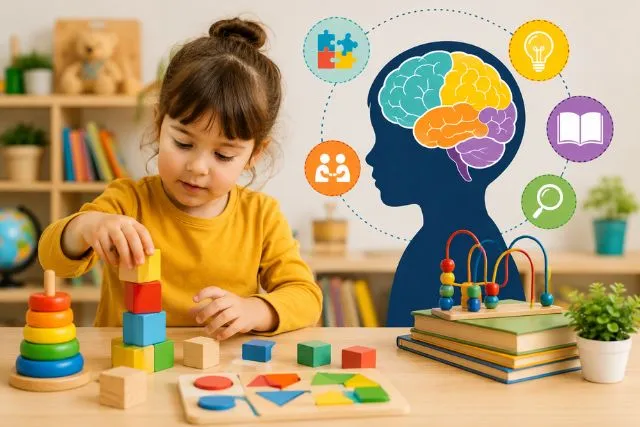
Understanding how children think, learn, and solve problems is one of the most fascinating aspects of parenting and education. Every child develops at their own pace, but there are common patterns in how their thinking evolves over time. One of the most influential explanations of this process is Piaget’s Theory, developed by Swiss psychologist Jean Piaget.
Piaget believed that children are not passive learners who simply absorb information from adults. Instead, they actively explore their surroundings, ask questions, experiment, and gradually build their understanding of the world. This revolutionary idea transformed child psychology and continues to shape modern education today.
Although Piaget’s Theory was first introduced nearly a century ago, it remains one of the most widely studied frameworks in developmental psychology. Teachers use it to design age-appropriate learning experiences, while parents can use its principles to better understand how their children grow, think, and solve everyday problems.
In this comprehensive guide, you’ll discover what Piaget’s Theory is, the four stages of cognitive development, the key concepts behind the theory, its strengths and limitations, and practical ways parents and teachers can support children’s learning at every stage.
Who Was Jean Piaget?
Jean Piaget (1896–1980) was a Swiss psychologist, biologist, and one of the pioneers of developmental psychology. Throughout his career, he dedicated his research to understanding how children develop knowledge and how their thinking changes from infancy to adolescence.
Before Piaget’s work, many people believed children simply knew less than adults. Piaget challenged this belief by showing that children actually think in fundamentally different ways. As they grow, they don’t just learn more facts—they develop entirely new ways of reasoning, solving problems, and making sense of the world.
Through decades of observation and research, Piaget discovered that children’s thinking develops through a series of predictable stages. Each stage represents important changes in how children understand objects, language, numbers, relationships, and abstract ideas.
His groundbreaking work influenced education across the globe and inspired child-centred teaching methods that encourage curiosity, exploration, and hands-on learning rather than memorisation alone.
Today, many educational approaches, including inquiry-based learning, Montessori education, and play-based learning, continue to reflect principles inspired by Piaget’s Theory.
What Is Piaget’s Theory?
Piaget’s Theory, also known as Piaget’s Cognitive Development Theory, explains how children’s thinking develops over time. Instead of viewing children as passive learners who simply absorb information, Piaget believed they actively construct knowledge through their experiences and interactions with the world.
According to Piaget’s Theory, every experience—whether playing with blocks, reading a book, asking questions, or exploring nature—helps children build a deeper understanding of how the world works. As they encounter new situations, they adjust their thinking and develop more advanced reasoning skills.
This process is known as constructivism, a learning theory that suggests knowledge is built through active exploration rather than passive instruction. In simple terms, children learn best by doing.
For example, imagine a toddler repeatedly drops a spoon from a high chair. While adults may see this as playful behaviour, the child is actually experimenting. They are discovering concepts such as gravity, cause and effect, and object movement through firsthand experience. These everyday interactions gradually shape their understanding of the world.
Unlike theories that focus mainly on intelligence or memory, Piaget’s Theory explains how thinking itself develops. It provides valuable insights into why children behave differently at different ages and why learning activities should match a child’s stage of cognitive development.
Why Is Piaget’s Theory Important?
One of the biggest contributions of Piaget’s Theory is that it helps parents, teachers, and caregivers understand that children are not simply “small adults.” Their brains process information differently depending on their stage of development. Understanding these changes alongside important child development milestones can help adults better support children’s learning and overall growth.
For example:
- A toddler learns mainly through touching, tasting, and exploring objects.
- A preschooler enjoys imaginative play but may struggle to understand another person’s perspective.
- A primary school child begins solving logical problems using real-life examples.
- Teenagers gradually develop the ability to think abstractly, plan for the future, and evaluate complex ideas.
Recognising these developmental differences allows adults to create learning experiences that are both realistic and age-appropriate. Rather than expecting children to master concepts before they are developmentally ready, Piaget’s Theory encourages supporting learning at each stage with patience, exploration, and meaningful experiences.
Core Concepts Behind Piaget’s Theory
Before exploring the four stages of cognitive development, it’s important to understand the key ideas that explain how children learn. Piaget introduced four core concepts that work together to describe the learning process: schemas, assimilation, accommodation, and equilibration.
These concepts explain how children organise information, adapt to new experiences, and gradually build a more accurate understanding of the world around them.
Schemas
A schema is a mental framework or organised pattern of knowledge that helps children understand and interpret new experiences.
From birth, children begin creating schemas through everyday interactions with people, objects, and their surroundings.
For example:
- A baby develops a grasping schema by picking up toys.
- A toddler builds an animal schema after seeing dogs, cats, and birds.
- A school-age child develops a number schema through counting and mathematics.
As children gain new experiences, these schemas become richer, more organised, and increasingly sophisticated.
Assimilation
Assimilation occurs when children interpret new information using knowledge they already possess.
Example
Suppose a child has learned that dogs have four legs, fur, and wagging tails.
The first time they see a wolf, they excitedly say,
“Look! It’s a dog!”
The child is applying an existing schema to understand something unfamiliar. This is assimilation.
Assimilation allows children to make sense of new experiences quickly by connecting them to what they already know.
Accommodation
Sometimes new experiences don’t fit into existing schemas. When this happens, children must adjust their understanding or create entirely new mental frameworks. This process is known as accommodation.
Example
After learning that wolves and dogs are different animals, the child updates their understanding.
Instead of calling every similar animal a dog, they now recognise separate categories for dogs, wolves, and foxes.
Accommodation enables children to refine their thinking and build more accurate knowledge over time.
Equilibration
According to Piaget’s Theory, learning is a continuous process of balancing assimilation and accommodation. This balance is called equilibration.
Children naturally seek to make sense of their experiences. Whenever they encounter information that challenges what they already know, they experience a temporary state of confusion. Through exploration, observation, and practice, they gradually restore balance by updating their understanding.
For instance, a child learning to ride a bicycle may initially struggle with balance and coordination. After repeated attempts and adjustments, they eventually master the skill. This ongoing process of trial, feedback, and improvement illustrates equilibration in everyday life.
How These Concepts Work Together
Imagine a child visiting a farm for the very first time.
They see a sheep and confidently call it a dog because it has four legs and fur (assimilation).
A parent gently explains that the animal is actually a sheep, not a dog. The child updates their understanding (accommodation).
Later, when they visit another farm, they can correctly identify dogs, sheep, goats, and cows without confusion. Their knowledge has become more organised through equilibration.
This simple example demonstrates the heart of Piaget’s Theory: children actively build knowledge through experience rather than simply memorising information. Every question they ask, every mistake they make, and every new experience contributes to their cognitive development.
What’s Next?
Now that we’ve explored the foundations of Piaget’s Theory, the next section examines Piaget’s Four Stages of Cognitive Development in detail. You’ll learn the characteristics of each stage, age ranges, practical examples, and simple activities parents and teachers can use to support children’s learning and development.
Piaget’s 4 Stages of Cognitive Development
One of the most significant contributions of Piaget’s Theory is the idea that children’s thinking develops through four predictable stages. Each stage represents a different way of understanding the world and solving problems.
Rather than moving through these stages on a strict timetable, children generally progress as their brains mature and they gain new experiences. Knowing these stages helps parents and teachers provide learning opportunities that match a child’s developmental needs.
Piaget’s Stages of Development at a Glance
| Stage | Age | Main Characteristics | How Parents Can Help |
|---|---|---|---|
| Sensorimotor Stage | Birth–2 years | Learning through senses and movement, object permanence | Encourage sensory play, tummy time, peekaboo, and stacking toys |
| Preoperational Stage | 2–7 years | Language growth, imagination, and symbolic thinking | Read stories, encourage pretend play, ask simple questions |
| Concrete Operational Stage | 7–11 years | Logical thinking, problem-solving with real objects | Use puzzles, experiments, maths games, and discussions |
| Formal Operational Stage | 12+ years | Abstract thinking, reasoning, and planning | Encourage debates, projects, critical thinking, and independent learning |
1. Sensorimotor Stage (Birth to 2 Years)
The Sensorimotor Stage is the first stage of Piaget’s Theory, where babies learn about the world through their senses and physical actions.
During this period, infants touch, taste, shake, throw, crawl, and observe everything around them. Every interaction helps build new brain connections and lays the foundation for future learning.
Key Characteristics
- Learning through movement and sensory experiences
- Exploring objects by touching and mouthing them
- Developing hand-eye coordination
- Recognising familiar faces and voices
- Understanding cause and effect
- Beginning to solve simple problems
Object Permanence
One of Piaget’s most famous concepts is object permanence—the understanding that objects continue to exist even when they are out of sight.
For example, a young baby may think a toy has disappeared when it’s hidden under a blanket. As they approach the end of this stage, they realise the toy is still there and actively search for it.
Everyday Example
A baby repeatedly drops a spoon from their high chair.
While adults may find this repetitive, the baby is actually conducting a simple experiment. They are learning about gravity, sound, movement, and how adults respond.
Activities for Parents
- Play peekaboo.
- Offer textured toys for sensory exploration.
- Encourage crawling and safe movement.
- Read picture books together.
- Provide stacking cups and soft blocks.
- Let babies safely explore different objects.
2. Preoperational Stage (2 to 7 Years)
The Preoperational Stage marks a major leap in cognitive development. Children begin using language rapidly, engage in imaginative play, and start representing ideas using words, pictures, and symbols.
However, their thinking is still largely intuitive rather than logical.
Key Characteristics
- Rapid language development
- Symbolic thinking
- Rich imagination
- Pretend play
- Curiosity and frequent questions
- Difficulty understanding another person’s perspective
Egocentrism
Children at this stage often assume everyone sees the world exactly as they do.
For example, a child may hide their eyes during hide-and-seek and believe nobody else can see them.
This doesn’t mean they are selfish—it simply reflects how their thinking is still developing.
Everyday Example
A cardboard box becomes a spaceship.
A stick becomes a magic wand.
A teddy bear becomes a classroom student.
These imaginative activities help children develop creativity, communication, and problem-solving skills.
Activities for Parents
- Encourage pretend play.
- Read books every day.
- Build with blocks.
- Draw and colour together.
- Ask open-ended questions.
- Visit parks, museums, and nature centres.
3. Concrete Operational Stage (7 to 11 Years)
During the Concrete Operational Stage, children become much more logical in their thinking. They begin understanding rules, relationships, and cause-and-effect situations involving real objects and everyday experiences.
Although abstract ideas may still be difficult, logical reasoning improves significantly.
Key Characteristics
- Logical thinking
- Better problem-solving
- Understanding conservation
- Improved memory
- Classification skills
- Organising information
Conservation
Piaget discovered that children at this stage understand that quantity remains the same even when appearance changes.
For example, if water is poured from a short glass into a taller, thinner glass, younger children may think there is now more water.
Children in the concrete operational stage understand that the amount of water has not changed.
Everyday Example
A child sorting toy animals into categories such as mammals, birds, reptiles, and fish demonstrates improved logical thinking and classification skills.
Activities for Parents
- Science experiments
- Sudoku and puzzles
- LEGO building challenges
- Board games
- Maths activities
- Cooking together using measurements
4. Formal Operational Stage (12 Years and Older)
The Formal Operational Stage is the final stage in Piaget’s Theory.
At this stage, children and teenagers develop the ability to think beyond the present moment. They can imagine possibilities, analyse situations, develop hypotheses, and consider multiple perspectives before reaching conclusions.
Key Characteristics
- Abstract thinking
- Critical reasoning
- Scientific thinking
- Planning for the future
- Hypothesis testing
- Independent decision-making
Teenagers become capable of discussing topics such as climate change, ethics, politics, careers, and scientific discoveries.
Everyday Example
A teenager researching renewable energy compares different sources, evaluates evidence, considers environmental impacts, and forms their own conclusion.
This type of reasoning reflects advanced cognitive development.
Activities for Parents
- Encourage debates and discussions.
- Support independent research projects.
- Introduce coding or robotics.
- Play strategy-based games such as chess.
- Discuss current events.
- Encourage goal setting and long-term planning.
Real-Life Examples of Piaget’s Theory
One reason Piaget’s Theory remains popular is that parents can observe its principles in everyday life.
Here are a few practical examples:
At Home
A toddler repeatedly presses the buttons on a musical toy to discover which sounds it makes. Through trial and error, they begin to understand cause and effect.
During Play
A five-year-old pretends a sofa is a pirate ship and uses cushions as treasure islands. This imaginative play strengthens symbolic thinking and creativity.
In School
A nine-year-old measures ingredients during a science experiment and understands that changing the container does not change the amount. This demonstrates concrete operational thinking.
As Teenagers
A fourteen-year-old compares different universities before deciding which subjects to study. They evaluate options, consider future goals, and think abstractly—key features of the formal operational stage.
Why Is Piaget’s Theory Still Relevant Today?
Although Jean Piaget introduced his theory nearly a century ago, Piaget’s Theory continues to influence modern education, child psychology, and parenting. While researchers have refined some aspects of his work, the core idea—that children actively build knowledge through experience—remains widely accepted.
Today, many schools encourage hands-on learning, problem-solving, collaborative activities, and play-based education, all of which reflect Piaget’s principles. Instead of expecting children to memorise information, educators increasingly focus on helping them explore, ask questions, and discover answers independently.
For parents, Piaget’s Theory offers valuable insight into why children think and behave differently at different ages. Understanding these developmental stages can make it easier to set realistic expectations, support learning at home, and respond patiently to a child’s curiosity.
Ultimately, Piaget’s greatest contribution was changing how we view children—not as miniature adults, but as active learners whose understanding grows through exploration and meaningful experiences.
Strengths of Piaget’s Theory
Piaget’s Theory has remained influential because it provides a practical framework for understanding children’s cognitive development.
Some of its greatest strengths include:
- Recognises children as active learners rather than passive recipients of information.
- Explains how thinking develops gradually through experience.
- Encourages age-appropriate teaching strategies.
- Supports play-based and discovery learning.
- Helps parents understand normal developmental milestones.
- Continues to influence educational practices worldwide.
By focusing on how children learn instead of simply what they learn, Piaget transformed developmental psychology and modern education.
Limitations of Piaget’s Theory
Despite its lasting impact, Piaget’s Theory has some limitations that modern researchers have identified.
For example, studies suggest that some children develop certain cognitive skills earlier than Piaget originally proposed, especially when they receive guidance from adults or learn in supportive social environments.
Piaget also focused primarily on individual exploration, while later psychologists highlighted the important role of culture, language, and social interaction in learning.
Additionally, not every child develops at exactly the same pace. Factors such as personality, environment, education, and life experiences all influence cognitive development.
These limitations do not make Piaget’s work incorrect. Instead, they show that child development is more complex than any single theory can fully explain. Today, many educators combine Piaget’s ideas with findings from more recent developmental research to create balanced learning approaches.
Piaget vs Vygotsky: What’s the Difference?
Jean Piaget and Lev Vygotsky are two of the most influential psychologists in child development. Both believed children actively learn about the world, but they explained the learning process differently.
| Piaget’s Theory | Vygotsky’s Theory |
|---|---|
| Children learn through independent exploration. | Children learn through social interaction and guidance. |
| Development comes before learning. | Learning can promote development. |
| Focuses on individual cognitive growth. | Focuses on culture, language, and collaboration. |
| Encourages discovery learning. | Encourages guided learning and scaffolding. |
| Emphasises developmental stages. | Does not divide development into fixed stages. |
Rather than viewing these theories as competing, many educators use ideas from both. Piaget helps explain how children’s thinking develops, while Vygotsky highlights the importance of learning with parents, teachers, and peers.
Together, these perspectives provide a more complete understanding of children’s cognitive development.
Practical Tips for Parents and Teachers
Understanding Piaget’s Theory is only valuable if it helps children learn more effectively. Here are some simple ways to apply its principles in everyday life.
Encourage Hands-On Learning
Children learn best by exploring. Let them build, experiment, create, and solve problems independently whenever possible.
Ask Open-Ended Questions
Instead of providing immediate answers, encourage children to think by asking questions such as:
- “Why do you think that happened?”
- “What do you think will happen next?”
- “Can you think of another solution?”
Support Learning Through Play
Pretend play, puzzles, building blocks, drawing, storytelling, and role-playing all strengthen cognitive development.
Choose Age-Appropriate Activities
Avoid expecting children to understand concepts that are beyond their developmental stage. Learning should be challenging but achievable.
Encourage Curiosity
Welcome questions, even when children ask “Why?” repeatedly. Curiosity is one of the strongest drivers of learning.
Remember Every Child Is Unique
Development is not a race. Some children master skills earlier, while others need more time. Focus on individual progress rather than comparisons.
Frequently Asked Questions
What is Piaget’s Theory?
Piaget’s Theory explains how children’s thinking develops through four stages as they grow. It suggests that children actively construct knowledge through exploration, experience, and interaction with their environment.
What are the four stages of Piaget’s Theory?
The four stages are:
- Sensorimotor Stage (Birth–2 years)
- Preoperational Stage (2–7 years)
- Concrete Operational Stage (7–11 years)
- Formal Operational Stage (12 years and older)
Each stage introduces new ways of thinking and understanding the world.
Why is Piaget’s Theory important?
It helps parents, teachers, and caregivers understand how children’s cognitive abilities develop, making it easier to provide age-appropriate learning experiences and realistic expectations.
Is Piaget’s Theory still relevant today?
Yes. Although modern research has expanded on some of Piaget’s ideas, his emphasis on active learning, exploration, and developmental stages continues to influence education and child psychology worldwide.
What is the difference between Piaget and Vygotsky?
Piaget believed children primarily learn through independent exploration, whereas Vygotsky emphasised the importance of social interaction, guidance, and cultural influences in learning.
How can parents use Piaget’s Theory at home?
Parents can support cognitive development by encouraging play, reading together, asking open-ended questions, providing hands-on activities, and allowing children to explore and solve problems independently.
Conclusion
Piaget’s Theory remains one of the most influential frameworks for understanding how children think, learn, and grow. By recognising that cognitive development happens gradually through active exploration, Piaget changed the way educators and parents support children’s learning.
Although no single theory explains every aspect of child development, Piaget’s ideas continue to provide valuable guidance for creating engaging, age-appropriate learning experiences. Whether you’re a parent encouraging curiosity at home or a teacher designing classroom activities, understanding Piaget’s Theory can help you better support children’s intellectual growth.
Most importantly, remember that every child develops at their own pace. Celebrate progress, encourage exploration, and provide opportunities for meaningful learning—because every new experience helps build the foundation for lifelong curiosity and success.
