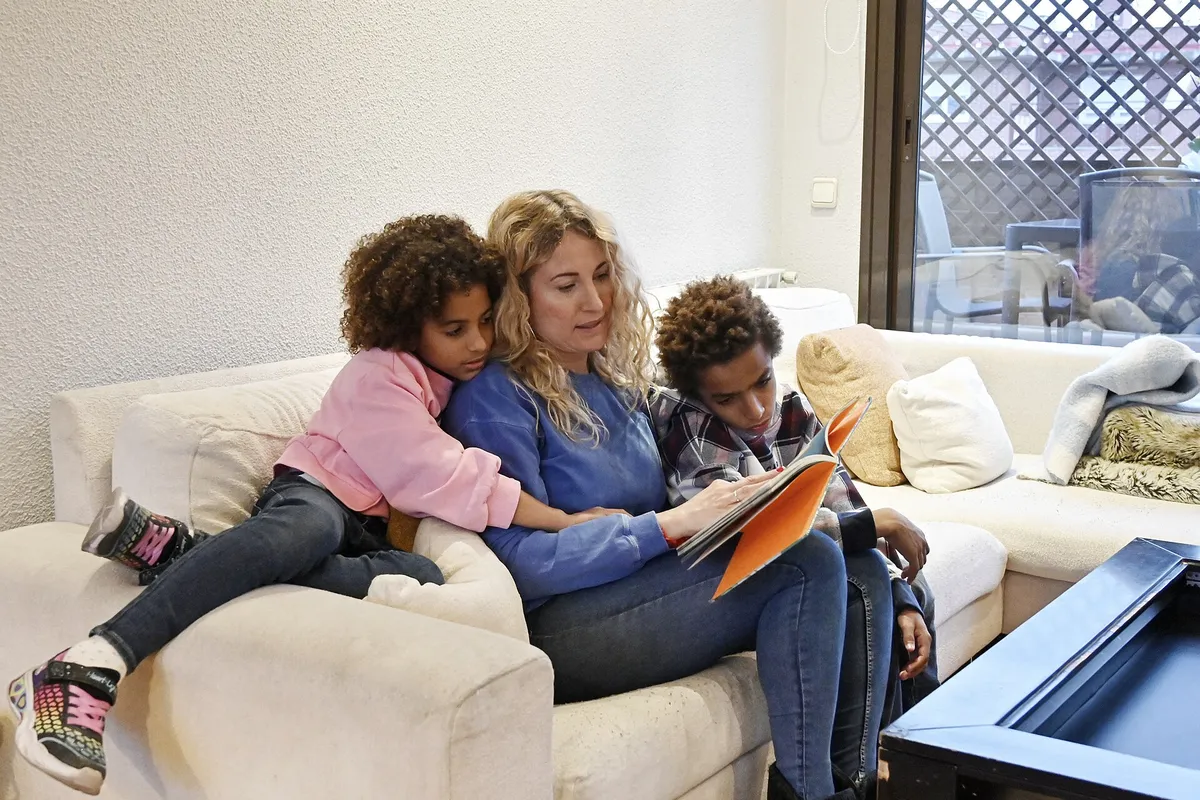
The best stories for 3-year-olds are short, a little bit silly and full of words to join in with. Below are five original short stories you can read aloud right now, free and with no sign-up. Each one takes two to three minutes, uses a world your child knows (puddles, buses, the park, Grandma’s garden) and has a repeating line for your child to shout out.
Each story also has a “join in” tip and a few questions to ask afterwards. These turn a two-minute story into the kind of back-and-forth talk that builds a three-year-old’s language. Further down you’ll find what makes a good story at this age, how to read aloud so it sticks, and nine picture books that UK three-year-olds love.
The short answer
- Read one now: Little Duck Wants to Play (friendship), Ted’s Red Wellies (rainy days), All Aboard the Number 5 Bus (counting), Who’s Hiding in the Garden? (guessing game), Goodnight, Little Fox (bedtime).
- What works at three: 2–5 minutes, a repeating line, sound words, a familiar setting and one simple problem.
- How to read them: pause before the refrain so your child can say it, then ask one or two questions afterwards.
- Story finder
- The 5 stories
- What makes a good story
- Why it matters
- How to read aloud
- Picture books to try
- FAQs
Story finder: 5 short stories for 3-year-olds at a glance
Pick a story by mood or moment. Read-aloud times assume a gentle pace of about 120 words a minute, which leaves room for pauses and noises.
| Story | Read-aloud time | Words | What it’s about | Best for |
|---|---|---|---|---|
| 1. Little Duck Wants to Play | 3 min | 301 | Friendship · being good at different things | Any time |
| 2. Ted’s Red Wellies | 2 min | 291 | Sizes: small, middle, big · outdoor play | Rainy days |
| 3. All Aboard the Number 5 Bus | 2 min | 292 | Counting 1 to 5 · sounds · a trip to the seaside | Car and bus journeys |
| 4. Who’s Hiding in the Garden? | 2 min | 284 | Guessing game · minibeasts and animals | Before a walk outside |
| 5. Goodnight, Little Fox | 2 min | 227 | Calm bedtime story · slow breathing | Bedtime |
5 short stories for 3-year-olds to read aloud
The lines in blue are the refrains. Read them with a big voice the first time. By the second or third time, pause and let your child say them.
Little Duck Wants to Play
Little Duck lived on the pond in the park. One sunny morning she paddled to the edge of the water and looked around.
“Quack, quack! Will you play with me?”
Frog was sitting on a lily pad. “Ribbit, ribbit! I’m jumping,” said Frog. Boing! Boing! Boing! went Frog.
Little Duck tried to jump too. Up she went… and SPLASH! Down she came. Ducks are not very good at jumping.
“Quack, quack! Will you play with me?”
Squirrel was in the big oak tree. “I’m climbing,” said Squirrel. Scritch, scratch, scritch went Squirrel, all the way to the top.
Little Duck tried to climb too. Flap, flap… bump! Ducks are not very good at climbing.
“Quack, quack! Will you play with me?”
Dog was on the path. “Woof, woof! I’m running,” said Dog. Zoom! went Dog, round and round the bench.
Little Duck tried to run too. Waddle, waddle, wobble… plop! She sat down on her bottom. Ducks are not very good at running.
Little Duck felt sad. “I can’t jump. I can’t climb. I can’t run,” she said quietly.
Then a big grey cloud came over the park. Pitter, patter, pitter, patter. It was raining!
Frog hid under a leaf. Squirrel hid in her hole. Dog ran home to his basket.
But Little Duck didn’t hide. She LOVED the rain. She splashed and paddled and swam round and round in circles.
Frog peeped out from under his leaf. “Little Duck,” he said, “what are you doing?”
“I’m swimming!” said Little Duck. “I’m very good at swimming.”
“Will you show me how?” asked Frog.
So Frog jumped in, and Little Duck showed him. Paddle, paddle, kick! Paddle, paddle, kick!
“Quack, quack!” “Ribbit, ribbit!” They played in the rain all morning long.
The end.
Join in: “Quack, quack! Will you play with me?” Do the animal noises together, and let your child make the SPLASH as big as they like.
- What was Little Duck good at? What are you good at?
- How did Little Duck feel when she fell on her bottom? What could her friends say to help?
- Which animal noise was your favourite?
Ted’s Red Wellies
Ted had new wellies. They were red. They were shiny. They had a little frog on each side.
“Can I wear them now?” asked Ted.
Mum looked out of the window. The sky was grey and the path was wet. “Coat on,” said Mum. “Let’s go and find some puddles.”
At the garden gate there was a little puddle. A tiny, titchy, little puddle.
Ted jumped in with his big red wellies. One, two, three… splish!
Just a little splish. “That puddle is too small,” said Ted.
By the post box there was a middle-sized puddle. Not too small, not too big.
Ted jumped in with his big red wellies. One, two, three… splash!
Water went on Ted’s coat. Water went on Ted’s nose. Ted laughed. “Can we find a bigger one?”
In the park, by the swings, there was a puddle so big that the clouds were in it. It was a huge, enormous, gigantic puddle.
Ted stood at the edge. He looked at Mum. Mum smiled and nodded.
Ted jumped in with his big red wellies. One, two, three… SPLOSH!
Muddy water went up and up and down and down. It went on Ted. It went on Mum. It even went on a pigeon, who flapped away crossly.
“Oops,” said Ted.
“Oops,” said Mum, and she jumped in too.
When they got home, Ted put his wellies by the door. They weren’t shiny any more. They were brown and muddy and very, very happy.
Ted had a warm bath with lots of bubbles. Then he looked out of the window. Pitter, patter, pitter, patter went the rain.
“Mum,” said Ted, “will there be puddles tomorrow?”
“I think,” said Mum, “there will be lots.”
The end.
Join in: Count “One, two, three…” together and shout SPLASH! Make the splash quieter for the little puddle and louder for the big one.
- Which puddle was the smallest? Which was the biggest?
- What colour were Ted’s wellies at the start? What colour were they at the end?
- Where is the best puddle near our house?
All Aboard the Number 5 Bus
Bev drove the number 5 bus. It was big and red, and it went all the way to the seaside.
Brrm, brrm! went the bus. Ding, ding! went the bell.
At the first stop, ONE girl got on. Her name was Ama, and she had a yellow balloon. “Hello, Bev!” she said.
Brrm, brrm! went the bus. Ding, ding! went the bell.
At the next stop, TWO grandads got on. They had flat caps and a flask of tea. “Morning!” they said together.
Brrm, brrm! went the bus. Ding, ding! went the bell.
At the next stop, THREE ducks got on. They walked in a line, one, two, three. “Quack, quack, quack!” Bev didn’t even ask for their tickets.
Brrm, brrm! went the bus. Ding, ding! went the bell.
At the next stop, FOUR footballers got on. They had muddy knees and a big round ball. “We won!” they cheered.
Brrm, brrm! went the bus. Ding, ding! went the bell.
At the next stop there was… ONE very big, very hairy, very waggy dog. Was there room?
The grandads squeezed up. The ducks sat on a footballer’s lap. Ama held her balloon up high. And the big dog sat right at the back with his tongue hanging out.
Brrm, brrm! went the bus. Ding, ding! went the bell.
Over the hill and round the bend they went, until everyone could see something blue and sparkly.
“The sea!” shouted Ama.
“Last stop,” said Bev. “Everybody off!”
Off got the girl, the grandads, the ducks, the footballers and the very big dog. They ran down to the sand, and the ducks went straight into the water.
Bev turned off the engine, took off her shoes and paddled too.
Ding, ding! The end.
Join in: Ring the bell with a finger in the air: “Ding, ding!” Then count the new passengers on your fingers as they climb aboard.
- How many grandads got on the bus? How many ducks? Can you show me on your fingers?
- Who got on last? Why was it a squeeze?
- If you got on the bus, what would you bring?
Who’s Hiding in the Garden?
Lily and Grandma went into the garden. “Let’s play a game,” said Grandma. “Someone is hiding. I’ll give you a clue, and you guess.”
Grandma pointed at the long grass. “I have long, floppy ears. I have a fluffy white tail. I love to hop, and I love to nibble carrots.
Who am I?”
Lily looked in the long grass. Out hopped… a RABBIT! “Hello, Rabbit!”
Grandma pointed at a big stone. “I am very, very slow. I leave a shiny, silvery trail. I carry my house on my back.
Who am I?”
Lily looked behind the stone. There was… a SNAIL! “Hello, Snail! You don’t have to hurry.”
Grandma pointed at a rose leaf. “I am very small. I am red with black spots. I can open my back and fly away.
Who am I?”
Lily looked at the leaf. There was… a LADYBIRD! It tickled her finger, then it flew away. Bye bye, Ladybird!
Grandma pointed at a pile of leaves under the hedge. “I am round and prickly. I sleep all winter. I snuffle and shuffle at night.
Who am I?”
Lily peeped very gently into the leaves. There, fast asleep, was… a HEDGEHOG! “Shh,” whispered Lily. “Night night, Hedgehog.”
“Now one more,” said Grandma, and she smiled. “I have two arms and two legs. I have ten fingers and ten toes. I have a big smile, and I love stories best of all.
Who am I?”
Lily looked behind the shed. She looked under the bench. She looked in the watering can. Then Grandma held up her little mirror.
“It’s ME!” laughed Lily.
“It’s YOU,” said Grandma, and gave her a big squeeze.
The end.
Join in: Pause after each “Who am I?” and let your child guess before you turn the page or read on. Wrong guesses are half the fun.
- Which animal was the slowest? Which one was asleep?
- Can you make up a clue for me to guess?
- What might be hiding in our garden or park?
Goodnight, Little Fox
Deep in the wood, under the roots of an old tree, there was a cosy den. And in the cosy den lived Little Fox.
“Time for sleep,” said Mummy Fox.
“But I’m not sleepy,” said Little Fox, and he wiggled his tail.
“Then let’s say goodnight to the wood,” said Mummy Fox.
Goodnight, wood. Goodnight, everyone.
Little Fox peeped out. High in a tree sat Owl. “Twit-twoo,” said Owl, very softly. “Goodnight, Owl,” whispered Little Fox.
Down by the stream, the water went trickle, trickle, trickle. “Goodnight, stream,” whispered Little Fox.
The wind went through the trees. Whoosh… whoosh… The leaves swayed gently, side to side. “Goodnight, trees,” whispered Little Fox.
Goodnight, wood. Goodnight, everyone.
Little Fox looked up. There was the moon, round and silver, and all around it were twinkly stars. One, two, three… too many stars to count.
“Goodnight, moon. Goodnight, stars,” whispered Little Fox. And he yawned a big, wide yawn.
Mummy Fox curled round him like a warm, furry blanket. “Let’s take a big, slow breath,” she said.
Little Fox breathed in… slowly, slowly… and out… slowly, slowly.
In… and out.
His paws felt heavy. His ears felt heavy. His tail stopped wiggling and lay still.
Goodnight, wood. Goodnight, everyone.
“Goodnight, Mummy,” whispered Little Fox.
“Goodnight, Little Fox,” said Mummy Fox. “Sleep tight.”
And Little Fox was fast asleep.
Join in: Read this one slowly and quietly. On “a big, slow breath”, breathe in and out together, and let your voice get softer as the story goes on.
- Keep talk to a minimum at bedtime. If your child wants to chat, ask: “Who else can we say goodnight to?” and name things in their room.
- In the daytime, ask: “What sounds did Little Fox hear in the wood?”
What makes a good story for a 3-year-old?
At three, most children can follow a simple story from start to finish, use short sentences and ask “why?” about everything. The stories that land best match that stage. Use this checklist when you choose a library book, or when you make up a story of your own at bedtime.
Rhyme is worth looking for, too. In a well-known study published in Nature in 1983, Lynette Bradley and Peter Bryant found that how well four- and five-year-olds could spot rhymes predicted how well they read and spelled years later. Three is a good age to start playing with rhyme in stories and songs.
Why reading to your 3-year-old matters
Researchers at Ohio State University worked out how many words children hear from picture books before they start school, depending on how often they are read to. The gap between “never” and “every day” is enormous.
Words heard from picture books by age five. Source: Logan JAR et al. (2019), “When Children Are Not Read to at Home: The Million Word Gap”, Journal of Developmental & Behavioral Pediatrics. The estimates assume a typical board or picture book and start from birth.
Books also use words that rarely come up in everyday talk, such as enormous, gently and crossly, which are all in the stories above. In England, communication and language is one of the three “prime areas” of the Early Years Foundation Stage (EYFS) that nurseries and pre-schools follow, and sharing stories is one of the main ways children build it. If you are curious about the thinking stage your child is in, our explainer on Piaget’s theory covers the “preoperational” years from two to seven.
How to read aloud to a 3-year-old so it sticks
You don’t need special voices or a perfect performance. What helps most is turning reading into a conversation. Researchers call this dialogic reading. Grover Whitehurst and colleagues developed it in the late 1980s, and it uses a simple four-step loop known as PEER:
- Pause before the refrain. Once your child knows “Will you play with me?”, stop and let them finish it.
- Follow their finger. If they point at the pigeon instead of Ted, talk about the pigeon. Interest beats sticking to the script.
- Link it to their life. “Ted went to the swings. Which swings do we go to?”
- Keep it short and stop while it’s fun. One story with lots of chat is worth more than three read straight through.
- Let them “read” it back. Retelling a story from the pictures, even if it changes every time, is a big step towards reading.
Looking for things to do once the book is closed? Act out Little Duck with toy animals, make a cardboard-box bus, or go on a garden minibeast hunt. Our indoor activities for kids and brain development activities have plenty more ideas.
9 picture books 3-year-olds love
When you’ve read our five stories a dozen times (and you will), these favourites are easy to find in UK libraries and bookshops. Joining your local library is free for children, and many run weekly rhyme times and story times for under-fives.
More stories and ideas from Kids Magazines
- Ready for something a little longer? Try our stories for 4-year-olds, written for children starting Reception.
- For older brothers and sisters: our short mystery The Case of the Moved Bookmark.
- Keep little hands busy with our educational activities to do at home.
Stories for 3-year-olds: your questions answered
What kind of stories are best for 3-year-olds?
Short stories of two to five minutes with a repeating line, sound words to join in with and a familiar setting such as a park, a bus or a garden. One small problem and a happy ending work best. Three-year-olds don’t need a twist, but they love being able to guess what happens next.
How long should a bedtime story be for a 3-year-old?
Around three to five minutes is enough for most three-year-olds. That might be one story read slowly, or a favourite read twice. A calm story with a quiet ending, like “Goodnight, Little Fox” on this page, is better at bedtime than an exciting one.
How many words should a story for a 3-year-old have?
Most picture books for this age have roughly 300 to 600 words. The five stories on this page run from about 227 to 301 words, so each takes about two to three minutes to read aloud.
Why does my 3-year-old want the same story again and again?
Repetition is how young children learn. Each time they hear a familiar story they notice new words, remember what comes next and enjoy being right. It’s normal and useful. Try pausing before a line they know and letting them say it.
How can I get my 3-year-old to sit still for a story?
Let them hold the book or turn the pages, read with expression and funny voices, and pick stories with actions or noises to join in with. It’s fine if they wriggle or wander while they listen. Many three-year-olds are still taking it in.
Should I read to my 3-year-old every day?
Daily reading makes a measurable difference. A 2019 study from Ohio State University estimated that a child read one picture book a day hears about 296,660 more words from books by age five than a child who is never read to. Even five minutes a day counts.
When should I worry about my 3-year-old’s speech?
Children develop at different rates, but speak to your health visitor or GP if your three-year-old is hard for family to understand, isn’t putting words together into short sentences, or doesn’t seem to follow simple instructions. Our guide to signs your child may need speech therapy goes into more detail.
Sources: Logan JAR, Justice LM, Yumuş M, Chaparro-Moreno LJ (2019), “When Children Are Not Read to at Home: The Million Word Gap”, Journal of Developmental & Behavioral Pediatrics 40(5): 383–386; Bradley L, Bryant PE (1983), “Categorizing sounds and learning to read: a causal connection”, Nature 301: 419–421; Whitehurst GJ et al. (1988), “Accelerating language development through picture book reading”, Developmental Psychology 24(4): 552–559; Department for Education: Statutory framework for the early years foundation stage. Stories © Kids Magazines. Featured photo: Oscar del Pozo / European Commission Audiovisual Service, Wikimedia Commons, CC BY 4.0.