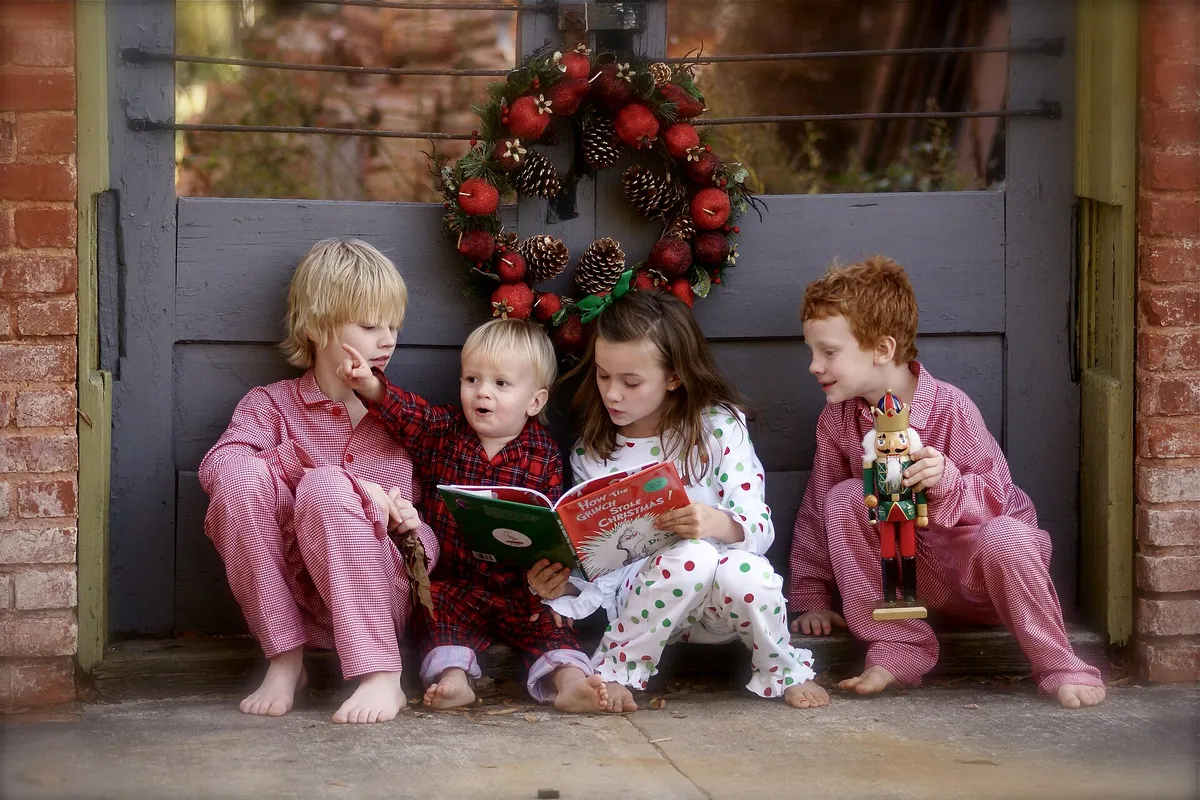
Stories for 4-year-olds need a real plot, a bit of a giggle and a problem your child can recognise. Here are five original stories written for the Reception age group, free to read aloud. Each takes three to four minutes and covers something four-year-olds really go through: starting school, falling out with a sibling, losing something, being scared of the dark, and inventing whole worlds from a cardboard box.
Every story comes with a “join in” idea and questions for afterwards. There is also a bonus first story for your child to read to you, written with the sounds most children learn in their first term of Reception. Further down: how to help your child retell a story, what happens with reading in Reception, and nine picture books to borrow next.
The short answer
- Read one now: Maya’s Pebble (starting school), The Biggest Sandcastle in the World (teamwork), Oscar’s Lost Mitten (memory and order), Dot the Dragon Is Scared of the Dark (bedtime worries), Rosie’s Rocket (imagination).
- What works at four: 4–8 minutes, a character with a problem, humour, feelings and something to join in with.
- Starting phonics? Try Pip and the Big Bug, a 10-line story your child can sound out.
- Story finder
- The 5 stories
- Read-it-yourself story
- Retelling a story
- Reading in Reception
- Picture books to try
- FAQs
Story finder: stories for 4-year-olds at a glance
Choose by mood, moment or what your child is going through. Times assume a relaxed read-aloud pace of about 120 words a minute.
| Story | Read-aloud time | Words | What it’s about | Best for |
|---|---|---|---|---|
| 1. Maya’s Pebble | 3 min | 415 | Starting school · feeling nervous · kindness | The weeks before Reception |
| 2. The Biggest Sandcastle in the World | 3 min | 395 | Teamwork · trying again · the seaside | Before a beach trip |
| 3. Oscar’s Lost Mitten | 3 min | 371 | Retracing steps · remembering the order · winter | Cold, frosty days |
| 4. Dot the Dragon Is Scared of the Dark | 3 min | 386 | Fear of the dark · friendship · shadows | Children who worry at bedtime |
| 5. Rosie’s Rocket | 3 min | 344 | Imaginative play · counting down from 10 · space | Rainy afternoons |
| Bonus: Pip and the Big Bug | 1 min | 65 | A first story for your child to read to you | Children starting phonics |
5 original stories for 4-year-olds to read aloud
Lines in blue repeat through the story. After the first one, pause and see if your child can say the next one for you.
Maya’s Pebble
On the night before Maya started school, Nan came round with something in her pocket.
“Hold out your hand,” said Nan. She put a small grey pebble in Maya’s palm. It was smooth and cool, with a white stripe right across the middle.
“I found it on the beach when I was your age,” said Nan. “If you ever feel wobbly, hold it tight and take a big breath.”
In the morning, Maya’s new jumper felt scratchy and her new shoes felt stiff. At the school gate there were lots of children and lots of noise.
Maya felt wobbly. She held her pebble tight and took a big breath.
Her teacher, Mrs Okafor, had a big smile and earrings shaped like stars. “Welcome, Maya,” she said. “Let’s find your peg.” Maya’s peg had her name on it and a picture of a ladybird. She hung her coat up all by herself.
Then it was carpet time. Everyone sat in a circle and said their names. When it was Maya’s turn, her voice went small and squeaky.
Maya felt wobbly. She held her pebble tight and took a big breath.
“Maya,” she said again, a bit louder. Mrs Okafor gave her a thumbs up.
At choosing time, Maya went to the painting table. A boy was standing next to the easel. He had a paintbrush in his hand and tears on his cheeks.
“I want my dad,” he said.
Maya knew that feeling. It was a wobbly feeling. She looked at her pebble. She didn’t want to give it away, because it was Nan’s. But she could share it.
“My nan says if you feel wobbly, you hold something smooth and take a big breath,” said Maya. “You can hold my pebble. Just for a bit.”
The boy held the pebble. He took a big breath. Then another one. “I’m Leo,” he said.
Maya and Leo painted a picture together. It was a beach, with a big yellow sun and a grey pebble with a white stripe. When it was time to tidy up, Leo gave the pebble back.
At home time, Nan was waiting at the gate. “How was it?” she asked.
“A bit wobbly,” said Maya. “And a bit lovely. Your pebble helped two people today.”
The next morning, Leo ran up to Maya in the playground. He opened his hand. Inside was a shiny brown conker.
“For when you feel wobbly,” he said.
The end.
Join in: Every time Maya feels wobbly, wobble your body with her, then hold an imaginary pebble together and take a breath.
- What made Maya feel wobbly? What makes you feel wobbly?
- Why didn’t Maya give the pebble away for keeps?
- What could you do if someone at school looked sad?
The Biggest Sandcastle in the World
Alfie and his big sister Isla were at the seaside with Grandad. The sand was golden and the sea was far, far away.
“Let’s build the biggest sandcastle in the world,” said Alfie.
“With a moat,” said Isla.
“With towers,” said Alfie.
“A MOAT,” said Isla.
“TOWERS,” said Alfie, and he stamped his foot, which is hard to do on sand.
Grandad sat on his stripy chair and opened his flask. “Why not both?” he said.
So Isla dug the moat. Dig, dig, dig! And Alfie built the towers. Fill the bucket, pat, pat, pat, turn it over… and lift! One tower. Two towers. Three towers, four towers, five!
Dig, dig, dig! Pat, pat, pat! The castle grew and grew.
They put shells on the walls for windows. They put seaweed on top for flags. Isla found a feather and stuck it on the tallest tower. A seagull landed nearby and looked at it very hard.
“It’s the biggest sandcastle in the world,” said Alfie.
But while they had been building, the sea had been creeping closer. Swish… swoosh… Swish… swoosh…
A little wave filled up the moat. “Hooray!” said Isla. “That’s what moats are for!”
A bigger wave came over the wall. Then a BIG wave came over everything. When it went back out, the towers were gone. There was just a bumpy lump of sand with a feather on top.
Alfie’s lip went wobbly. “It’s ruined,” he said.
Grandad put his arm round him. “The sea’s just borrowed it,” he said. “It does that every day. Twice, in fact. That’s called the tide.”
Isla looked at the bumpy lump. Then she looked up the beach, where the sand was dry. “Alfie,” she said, “if we build it up there, the sea can’t reach.”
“With towers?” said Alfie.
“With towers,” said Isla. “And a moat.”
Dig, dig, dig! Pat, pat, pat! The castle grew and grew.
This time they worked together. Isla dug and Alfie patted. Alfie dug and Isla patted. It was even bigger than before, and it had a moat AND six towers.
When it was time to go home, the sea was still coming in. It stopped just before the moat, swished once, and went back out.
“It knows,” said Alfie. “It knows it’s the biggest sandcastle in the world.”
The end.
Join in: Do the actions: dig, dig, dig with your hands, and pat, pat, pat the top of the castle.
- Why did Alfie and Isla argue at the start? How did they sort it out?
- What happened to the first sandcastle? Why didn’t the sea reach the second one?
- Tell me about something you had to try again.
Oscar’s Lost Mitten
It was a frosty morning. Oscar wore his woolly hat, his warm coat and his blue mittens with the white snowflakes on.
Oscar and Dad walked to nursery. They posted a letter in the red post box. They bought a bread roll at the bakery. They sat on the bench in the park to feed the ducks. Then they waited at the bus stop for the bus.
When they got on the bus, Oscar looked at his hands. One blue mitten. And one cold, pink hand.
“Dad! I’ve lost a mitten!”
“Don’t worry,” said Dad. “Let’s go back the way we came.” So they got off the bus and walked back.
“Little blue mitten, where can you be?”
First they went to the bus stop. There was a lady with a shopping trolley. There was a puddle with ice on top. But there was no mitten.
“Little blue mitten, where can you be?”
Next they went to the park bench. There were three ducks, still hoping for bread. “Have you seen my mitten?” asked Oscar. “Quack,” said the ducks, which meant no.
“Little blue mitten, where can you be?”
Next they went to the bakery. It smelled of warm bread and cinnamon. The baker shook her head. “No mittens here,” she said, “but have a gingerbread man for being brave.”
“Little blue mitten, where can you be?”
Last of all, they went to the red post box. And there, on the railing right next to it, was a little blue mitten with white snowflakes. Someone kind had picked it up and popped it on the railing where it could be seen.
“There you are!” said Oscar, and he put it straight on. Now both his hands were warm.
“I took it off to post the letter,” said Oscar. “I remember now.”
“Good remembering,” said Dad. “We went back past the bus stop, the bench, the bakery and the post box. Just like the way we came, but backwards.”
On the way to nursery, Oscar saw a little red glove lying on the path. He picked it up and put it on top of a wall, where it could be seen.
“For whoever is looking,” he said.
The end.
Join in: Before each new place, ask: “Where did they go next?” By the end, see if your child can list all the places in order.
- Can you remember the four places Oscar went, in order? Use your fingers.
- Where was the mitten in the end? Why was it there?
- What did Oscar do with the red glove? Why?
Dot the Dragon Is Scared of the Dark
Dot was a dragon. She had green scales, a curly tail and two small wings that flapped when she was excited. But Dot had a secret. She was scared of the dark.
Every night, when the sun went down behind the hill, Dot hid under her blanket.
“Too dark! Too dark!” squeaked Dot.
One evening, a girl called Priya was walking home past Dot’s cave. She heard the squeak.
“Hello?” said Priya. “Are you all right?”
A green nose poked out of the blanket. “I’m a dragon,” said Dot, “and I’m scared of the dark.”
“But dragons breathe fire,” said Priya. “Can’t you just light it up?”
“Only when I sneeze,” said Dot sadly. “And then I burn my blanket.”
Priya sat down at the front of the cave. She took a torch out of her bag. “I used to be scared of the dark too,” she said. “What’s the scariest bit?”
Dot pointed a claw at the wall. There was a big, spiky, shadowy shape. “THAT,” she whispered.
Priya shone her torch on it. It was Dot’s own wing, folded up.
“Oh,” said Dot.
“Shadows are just things you already know, without their colours on,” said Priya. “Watch.” She put her hands in front of the torch, and a rabbit hopped across the cave wall. Then a bird. Then a crocodile, snap, snap!
Dot giggled. She held up her claws and made a shadow too. It was a dragon. A really, really big one.
“That’s me,” said Dot. “I look brave.”
“You ARE brave,” said Priya. “You’re talking to me in the dark right now.”
Dot looked around. It was dark. And she was… fine.
Then Dot laughed so much that her nose tickled. Her nose tickled so much that… ah… ahh… AH-CHOO! Out came a tiny puff of fire. It landed in an old lantern hanging on the wall, and the lantern began to glow, soft and orange and warm.
“A nightlight!” said Priya.
“A dragon light,” said Dot proudly.
Now, every night, Dot lights her lantern with a little sneeze. She makes shadow dragons on the wall until she’s sleepy. And when the sun goes down behind the hill, she doesn’t squeak at all.
“Not too dark,” says Dot. “Just right.”
The end.
Join in: When Dot says “Too dark! Too dark!”, say it in a little squeaky dragon voice together. Have a torch handy for shadow shapes afterwards.
- What did Dot think the scary shape was? What was it really?
- What helps you feel cosy at night?
- What shadow shapes can we make with a torch?
Rosie’s Rocket
The new fridge came in a big cardboard box. Mum unpacked the fridge. Rosie looked at the box.
“Can I have it?” asked Rosie.
“What for?” asked Mum.
“To go to the moon,” said Rosie.
Rosie drew round windows with a felt-tip. She stuck on buttons made from bottle tops. She made a pointy top out of a paper plate, and she wrote ROSIE’S ROCKET on the side in big wobbly letters. Her little brother Sam climbed in too.
“Seatbelts on,” said Rosie. Click! Click!
“Ten, nine, eight, seven, six, five, four, three, two, one… BLAST OFF!”
The rocket rumbled and shook. Up past the kitchen window. Up past the chimney pots. Up past the clouds, which felt like cold candyfloss.
It got darker and darker and the stars came out. “Look,” said Rosie. “There’s Earth. It looks like a big blue marble.” Sam waved at it.
Bump! They landed on the moon.
The moon was grey and dusty and full of holes called craters. When Rosie jumped, she floated up, up, up, and came down very slowly. Boing… boing… boing…
“We’re bouncing!” laughed Sam.
They made footprints in the moon dust. They planted a flag that was really a tea towel. They found a moon rock and put it in Rosie’s pocket to show Mum.
Then, from far away, they heard a voice. It crackled like a radio.
“Mission Control to Rosie’s Rocket. Fish fingers are ready. Over.”
Rosie pressed a bottle-top button. “Rosie’s Rocket to Mission Control. We’re coming home. Over.”
“Ten, nine, eight, seven, six, five, four, three, two, one… BLAST OFF!”
Down past the stars. Down through the candyfloss clouds. Down past the chimney pots and the kitchen window, until… BUMP! They landed on the kitchen floor.
Mum put two plates on the table. “How was the moon?” she asked.
Rosie reached into her pocket and pulled out the moon rock. It looked a lot like a grey pebble from the garden.
“Bouncy,” said Rosie. “Tomorrow we’re going to Mars.”
The end.
Join in: Count down from 10 to 1 together and shout BLAST OFF! Lift your child up (or bounce on the sofa) as the rocket takes off.
- What did Rosie use to make her rocket?
- What was the moon like? How did they move on the moon?
- If you had a big box, what would you turn it into?
How the five compare in length. All of them sit at the short end of what four-year-olds can manage, so you can easily read two in a row:
Bar length is out of 600 words, roughly the length of a typical picture book. Read-aloud times at about 120 words a minute.
Bonus: a first story your child can read to you
“Pip and the Big Bug” uses short words that can be sounded out letter by letter (p-u-p, m-a-t), the kind most children learn in their first term of Reception. It also has a few common “tricky words” such as the, is and to. The one word underlined in red, said, is a harder tricky word, so read that one for them.
Pip and the Big Bug
Pip is a pup.
Pip has a red hat.
Pip sat on a mat in the sun.
A big bug got on the mat.
“Hop off, bug!” said Pip.
The bug did not hop off.
It sat on Pip’s red hat!
Pip ran and ran to the pond.
The bug hid in the mud.
Pip is not sad. Pip has his hat. The end.
How to use it: let your child point to each word as they read. If they get stuck, say the sounds with them (“b-u-g”) and let them blend them into the word. Stop after a few lines if they’re tired. Reading half of it is still a win.
Not every four-year-old will be ready for this, and that’s completely fine. Many children won’t start phonics until they begin Reception, and they learn at very different speeds. If your child isn’t interested, put it away and come back in a few months.
How to help your 4-year-old retell a story
Retelling a story in their own words is one of the best signs that a child has understood it. It is also one of the things Reception teachers look for. A simple way in is the five-finger retell: one question for each finger. Here it is with “Oscar’s Lost Mitten”:
- Ask them to predict. Stop before the big moment (“What do you think is on the railing?”) and let them guess.
- Talk about feelings. “How did Alfie feel when the wave came? How do you know?” Naming feelings in stories helps children name their own.
- Swap the roles. Let your child tell you the story from the pictures, or act it out with toys. Changing the ending is creativity, not a mistake.
- Pick out a new word. Choose one interesting word per story (craters, moat, railing) and try to use it again that day.
What happens with reading in Reception?
In England, children start Reception in the September after their fourth birthday, so most four-year-olds will spend part of the year in a Reception class. The Department for Education expects every school to teach reading with a systematic synthetic phonics programme from the start of Reception. Exact timings depend on the programme your school uses, but a typical year looks like this:
Stories read aloud are still central. The Department for Education’s Reading Framework asks schools to read to children every day and to build their vocabulary through stories, rhymes and poems. Children can listen to and understand much richer language than they can read for themselves. If your child is about to start school and you’re thinking about the practical side, our guide to wearing glasses to school may help if your child has just got specs.
9 picture books 4-year-olds love
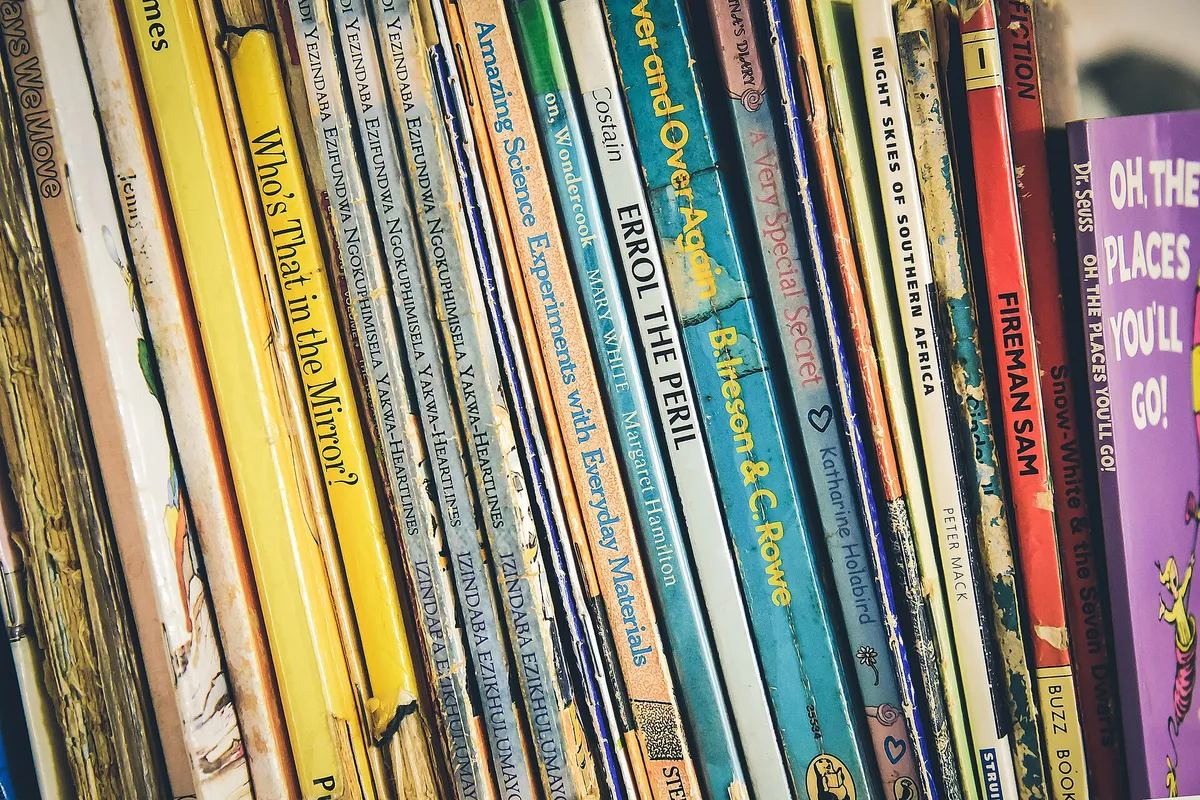
When you want something new, these are easy to find in UK libraries and bookshops. Most of them reward re-reading, which four-year-olds will insist on anyway.
More stories and ideas from Kids Magazines
- Reading with a younger sibling too? Our stories for 3-year-olds are shorter, with more noises to join in with.
- For older children who like a puzzle: The Case of the Moved Bookmark.
- Turn a story into play with our indoor activities for kids, or try rhyming games from rhyme without reason ideas.
- Wondering how your child’s thinking is developing? Read our explainer on Piaget’s theory.
Stories for 4-year-olds: your questions answered
What kind of stories do 4-year-olds like?
Four-year-olds are ready for a proper plot: a character with a problem, a few things that happen, and an ending that sorts it out. They love silly humour, imaginary adventures and stories about things they are going through, such as starting school, sharing and being scared of the dark. A repeating line still helps them join in.
How long should a story be for a 4-year-old?
Most four-year-olds enjoy stories of about four to eight minutes. That is roughly 400 to 800 words read aloud, which is the length of a typical picture book. The five stories on this page each take three to four minutes, so you can read one, or two at bedtime.
Can 4-year-olds read by themselves?
Some can read a few simple words, but most children in England start learning to read with phonics in Reception, the school year that begins in the September after they turn four. Short decodable stories like “Pip and the Big Bug” on this page are designed for that stage. Reading aloud to your child should carry on long after they can read themselves.
How do I help my 4-year-old understand a story?
Ask them to retell it in their own words using the five-finger retell: who, where, the problem, what happened next, and the ending. Pause to ask “What do you think will happen?” and talk about how the characters feel. Retelling and predicting are both part of the Early Learning Goals at the end of Reception.
What are good stories to prepare a 4-year-old for school?
Stories that show the routine of a school day, the feeling of being nervous, and making a new friend help most. “Maya’s Pebble” on this page was written for that moment, and Starting School by Janet and Allan Ahlberg and The Colour Monster by Anna Llenas are good to borrow from the library.
Is it OK to read the same book to my 4-year-old every night?
Yes. Re-reading helps children remember new words, notice details and retell the story themselves. If you want variety, keep the favourite as the last story and try something new first.
What should I do if my 4-year-old is scared of the dark?
It is a very common fear at this age. A dim nightlight, a calm bedtime routine and a story where a character gets over the same fear, such as “Dot the Dragon” above, can all help. Making shadow puppets with a torch in the daytime takes the mystery out of shadows. Our guide to deeply feeling kids has more on big emotions.
Sources: Department for Education: Statutory framework for the early years foundation stage (Early Learning Goals for Comprehension and Word Reading); Department for Education: The reading framework (2023); Department for Education / Standards and Testing Agency: Phonics screening check guidance; GOV.UK: School admissions, starting school age. Stories © Kids Magazines. Featured photo: scbailey, Wikimedia Commons, CC BY 2.0.