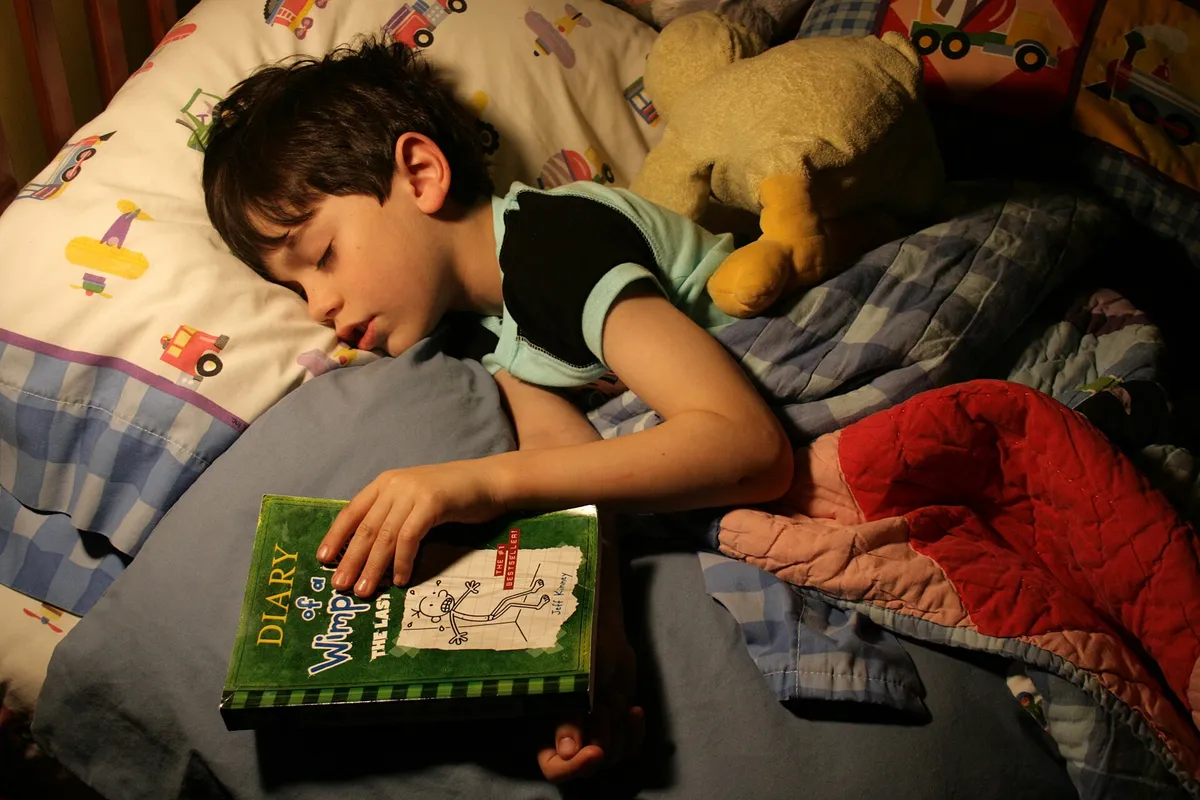
The best bedtime stories for 5-year-olds are short, gentle and slow down as they go. Here are five original calming bedtime stories, free to read aloud tonight. Each one takes three to five minutes and ends with someone drifting off to sleep: a boy on a slow night train, a snail who never hurries, a girl at Nana’s for the first time, a fox cub with a busy head, and a little boat rocked to sleep in a harbour.
The repeating lines get softer each time, so by the end you are almost whispering. Every story comes with a quiet way to join in and a couple of questions to talk about with the lights low. Further down: a simple bedtime routine for five-year-olds, four calm-down tricks, how much sleep a five-year-old needs, and nine bedtime books to borrow next.
The short answer
- Read one now: The Slow Night Train (vehicle fans), Sid the Snail Takes His Time (wriggly children), Nana’s Patchwork Quilt (sleepovers), Fern the Fox Counts the Stars (busy minds), Little Boat Goes to Sleep (the calmest, read it last).
- What works at five: 3–5 minutes per story, a gentle plot, no cliffhangers, a repeating line and an ending in bed.
- Sleep they need: 10–13 hours a day for ages 3–5, so a child up at 7am should be asleep by about 8pm.
Story finder: bedtime stories for 5-year-olds at a glance
Pick by what kind of night it is. Times assume a relaxed read-aloud pace of about 120 words a minute; at bedtime you may want to read a little slower than that.
| Story | Read-aloud time | Words | What it’s about | Best for |
|---|---|---|---|---|
| 1. The Slow Night Train | 3 min | 370 | Trains · animals settling down · going home | Busy children who love vehicles |
| 2. Sid the Snail Takes His Time | 3 min | 366 | Slowing down · noticing · the garden at dusk | Wriggly children who can’t settle |
| 3. Nana’s Patchwork Quilt | 3 min | 393 | Family · memories · sleeping somewhere new | Sleepovers and missing someone |
| 4. Fern the Fox Counts the Stars | 3 min | 348 | Busy minds · thinking of good things · counting | Children who lie awake thinking |
| 5. Little Boat Goes to Sleep | 3 min | 369 | The seaside · rocking · the quietest ending | The very last story of the night |
5 calming bedtime stories for 5-year-olds
Lines in blue repeat through each story. Say them a little more slowly and quietly every time, so the story winds down with your child. The stories run from the most lively to the calmest, so if you read two, read them in order.
The Slow Night Train
When Arlo had brushed his teeth and put on his pyjamas with the rockets on, he heard a sound outside his window. A soft, sleepy toot.
There, at the end of the garden, was a little blue train with one carriage. Its lamps glowed like honey. The driver was a badger in a peaked cap.
“All aboard the Slow Night Train,” said the badger. “We stop at every station, and we never, ever rush.”
Arlo climbed in. The seats were soft and green, with a blanket folded on each one. He tucked the blanket round his knees.
Clickety-clack, clickety-clack, the night train hums along the track.
The first station was Owl Wood. The trees were tall and dark, and the owls were just waking up. “Too-whit,” said one owl. “Too-whoo,” said another. “You sleep,” they called to Arlo. “We’ll keep watch.”
Clickety-clack, clickety-clack, the night train hums along the track.
The next station was Meadow Halt. In the long grass, the sheep were lying down in a woolly row. One sheep yawned. Then the next sheep yawned. Then all the sheep yawned, one after another, all the way along. Arlo yawned too. He couldn’t help it.
Clickety-clack, clickety-clack, the night train hums along the track.
The next station was Harbour Steps. The little boats were tied up for the night, rocking gently on the water. A fisherman was hanging up his nets. He waved a slow, sleepy wave.
The train went slower now, through a tunnel of trees. Arlo could hear the wheels going round and round. He could hear the badger humming a quiet tune. His eyes felt heavy, like warm pebbles.
Clickety-clack… clickety-clack… the night train hums along the track.
“Last stop,” said the badger softly. “This one’s yours.”
Arlo looked out of the window. There was his garden. There was his house. There was his bedroom window, with the little lamp still on.
The badger lifted Arlo down very gently. “The train will come again tomorrow night,” he whispered. “It always does.”
Arlo walked up the path in his rocket pyjamas. He climbed the stairs. He climbed into bed. Far away, he heard one last, sleepy toot.
Clickety… clack…
And Arlo was fast asleep.
Join in: Say the train line together, a little slower and a little quieter each time. By the last one, it should be a whisper.
- Which station would you like to get off at? Why?
- What did the sheep do that made Arlo yawn?
- Can you remember who the driver was?
Sid the Snail Takes His Time
At the bottom of the garden, under a big rhubarb leaf, lived a snail called Sid.
Sid had a stripy brown shell and two long feelers that went up and down. Every evening, when the sun went pink and the garden went quiet, Sid made the long journey from the strawberry patch to his favourite flowerpot, where he liked to sleep.
“Hurry up, Sid!” said a beetle, rushing past. “It’s nearly night!”
But Sid didn’t hurry.
Slowly, slowly, Sid went on. No need to hurry. No need at all.
First he came to the lawn. The grass was cool and a little bit damp. Sid stopped. He felt the cool grass under his tummy. He took a long, slow breath. Ahhh.
Slowly, slowly, Sid went on. No need to hurry. No need at all.
Next he came to the lavender bush. It smelled sweet and sleepy, like a warm bath. Sid stopped. He breathed in the lovely smell. He let it out again, slowly. Ahhh.
A bee was buzzing round the lavender. “Can’t stop, can’t stop,” buzzed the bee. “Must get home before dark!” And off it zoomed.
Slowly, slowly, Sid went on. No need to hurry. No need at all.
Next he came to the bird bath. A blackbird was singing on the edge, the last song of the day. It was a long, gentle song that went up and down, up and down. Sid stopped. He listened until the very last note. Then it was quiet.
The sky went from pink to purple. The first star came out, small and bright.
“Look,” said Sid to nobody in particular. “If I had hurried, I would have missed that.”
Slowly… slowly… Sid went on.
At last he reached his flowerpot. It was tipped on its side, with a soft bed of moss inside. Sid slid in. He tucked his feelers down, one, and then the other. His shell was warm. The moss was soft. The garden was quiet.
The beetle was asleep. The bee was asleep. The blackbird was asleep in the hedge.
“Goodnight, garden,” said Sid, in his smallest voice.
And Sid the snail, who never hurried, fell slowly, slowly asleep.
Join in: Every time Sid stops, stop too. Take one slow breath in through your nose, and let it out like a long, soft sigh.
- What did Sid feel, smell and hear on his journey?
- Why didn’t Sid hurry like the beetle and the bee?
- What was the nicest thing you noticed today?
Nana’s Patchwork Quilt
Zara was staying the night at Nana’s house for the very first time.
The spare room was nice, but it was different. The curtains were different. The bed creaked in a different way. Even the dark was a different shape.
“I can’t sleep,” said Zara. “It’s too new.”
Nana sat on the edge of the bed. She smoothed out the quilt. It was made of lots of squares of material, all different colours, stitched together with tiny stitches.
“This quilt isn’t new,” said Nana. “Every patch on it is a story. Shall I tell you some?”
Zara nodded.
Patch by patch, and stitch by stitch.
Nana touched a yellow square with white daisies. “This was my summer dress, when I was a little girl. I wore it to the seaside, and I ate an ice cream so fast it gave me a brain freeze.” Zara giggled.
Patch by patch, and stitch by stitch.
Nana touched a soft blue square with checks. “This was Grandad’s gardening shirt. He wore it every Saturday to grow his runner beans. It still smells a tiny bit of tomatoes, if you sniff very hard.” Zara sniffed. Maybe it did.
Patch by patch, and stitch by stitch.
Nana touched a red square with little white stars. “This was your mum’s school jumper. She wore it until the elbows had holes in.”
“Mum had holes in her elbows?” said Zara.
“Only in her jumper,” said Nana, and they both laughed quietly.
Zara’s eyes were getting heavy now. Nana’s voice was soft and slow.
Patch by patch… and stitch by stitch.
Right in the middle of the quilt was one more patch. It was pale green and very soft, like a rabbit’s ear.
“Whose is that one?” whispered Zara.
“That,” said Nana, “is a piece of the blanket you had when you were a tiny baby. I sewed it in the middle, so the whole family is all around it.”
Zara put her hand on the soft green patch. It didn’t feel new at all. It felt like home.
Nana kissed her forehead and turned the big light off. The little lamp glowed. The bed creaked, but it was a friendly creak now.
And Zara fell asleep with her hand on her very own patch, right in the middle of everyone.
Join in: Trace a square on your child’s back or hand for each patch, slowly, as you read it.
- Why did Nana’s spare room feel strange at first?
- Which patch was your favourite? Why?
- If we made a quilt, what would you want on your patch?
Fern the Fox Counts the Stars
In a den under an old oak tree, a little fox called Fern could not get to sleep.
Her brothers were asleep, curled up like orange cushions. Her mother was nearly asleep, with her bushy tail over her nose. But Fern’s head was full of thoughts, buzzing round and round like flies.
“Mama,” she whispered. “My head won’t be quiet.”
Mother Fox opened one eye. Then she stood up, stretched, and nudged Fern to the mouth of the den. Outside, the sky was dark and clear, and it was full of stars.
“When my head won’t be quiet,” said Mother Fox, “I count the stars. But for every star, I think of one good thing from my day.”
Fern looked up. She found a bright star, just above the oak tree.
One star, one good thing.
“I found a blackberry,” said Fern. “It was the juiciest one on the whole bush.”
She found another star, a little one, next to the first.
Two stars, two good things.
“I played chase with my brothers by the stream, and I won,” said Fern. “Twice.”
Mother Fox smiled. Fern found a third star, low down over the hill.
Three stars, three good things.
“An old rabbit said good morning to me,” said Fern, “even though I’m a fox.”
She looked for a fourth star. Her thoughts were slower now, like leaves floating down a stream.
Four stars… four good things.
“I saw a rainbow,” said Fern. Her voice was soft and sleepy. “After the rain. Over the farm.”
She looked for a fifth star. There were so many. Hundreds and hundreds.
“Mama,” Fern yawned, “I don’t think there are enough good things for all the stars.”
“There will be,” said Mother Fox. “You’ve got lots of days to fill them up.”
Fern crept back into the den. She curled up between her brothers, and her mother’s tail settled over her like a warm scarf.
Five stars… five good things…
“Five,” murmured Fern. “Being here.”
And the little fox’s head was quiet at last.
Join in: Count on your fingers with Fern. When the story ends, count three good things from your own day, slowly, one finger at a time.
- What did Fern do when her head was too busy?
- What were Fern’s good things? Can you remember any?
- What are three good things from your day?

Little Boat Goes to Sleep
In a small harbour by the sea, there was a little red boat called Little Boat.
All day long, Little Boat had been busy. She had chugged out past the lighthouse. She had bobbed on the waves while the fishermen caught their fish. She had raced a seagull home, and nearly won.
Now the sun was going down, and it painted the water orange and gold. The fishermen tied Little Boat to the harbour wall with a strong rope, and patted her side.
“Goodnight, Little Boat,” they said, and went home for their tea.
But Little Boat was not sleepy. “I want to go out again,” she said. “I want to see what’s out there in the dark.”
The sea came lapping up against her side. Lap, lap. Lap, lap.
“Hush,” said the sea. “Hush, hush.”
The big fishing boat next to her creaked on its rope. “Go to sleep, Little Boat,” it said in a deep, slow voice. “The night is for resting. The sea will still be there in the morning.”
Little Boat rocked gently. Side to side. Side to side.
“Hush,” said the sea. “Hush, hush.”
On the harbour wall, the seagulls tucked their heads under their wings. In the houses, the windows went yellow, and then, one by one, they went dark.
Out on the rocks, the lighthouse switched on its great big light. It turned slowly round and round. Flash… and dark. Flash… and dark. “I’ll watch the sea tonight,” said the lighthouse. “You rest.”
Little Boat felt the rope hold her safe. She felt the water rock her, side to side, side to side, like a cradle.
“Hush,” said the sea, more softly now. “Hush… hush…”
The moon came up over the water. It laid a silver path across the sea, all the way from the sky to Little Boat.
Little Boat thought about the waves she had bobbed on. She thought about the seagull she had raced. She thought about going out again tomorrow, in the morning, when the sun came up.
But not now.
Now the sea was rocking. Now the lighthouse was watching. Now the moon was shining.
“Hush,” whispered the sea.
And Little Boat went to sleep.
Join in: Rock gently from side to side with your child as Little Boat rocks. Say the “hush” line together, softer every time.
- Why didn’t Little Boat want to go to sleep?
- Who looked after the sea while Little Boat rested?
- Where will Little Boat go tomorrow, do you think?
How the five compare in length. All of them fit the three-to-five-minute sweet spot, so two in a row still makes a short, unhurried bedtime:
Bar length is out of 600 words, about five minutes read aloud. Read-aloud times at about 120 words a minute.
4 calm-down tricks to use with the stories
Each story has a calming idea built in. Once your child knows them, you can use them on their own on nights when sleep won’t come:
None of these needs to be perfect. If your child giggles through “goodnight, knees”, that’s fine: laughing together in a dim room is still winding down. If your child often finds big feelings hard to settle at night, our guide to deeply feeling kids may help.
A simple bedtime routine for 5-year-olds
The NHS recommends a regular bedtime routine for children: the same steps in the same order, at roughly the same time each night. At five, a routine of 45 minutes to an hour works for most families. Here is one that builds around the stories on this page:

- Keep the bedroom dark and cool. Thick curtains or a blackout blind help in British summers, when it can still be light at 9pm.
- Give a five-minute warning. “Five more minutes of play, then bath” avoids a sudden stop that leads to protest.
- Use a clock they can read. A colour-changing “OK to wake” clock helps early risers know when it’s morning. We compared some in our guide to the best alarm clocks for preschoolers.
- Keep weekends close. A bedtime more than an hour later on Friday and Saturday can make Monday mornings hard.
How much sleep does a 5-year-old need?
Five sits right on the line between two age groups in the sleep guidelines published by the American Academy of Sleep Medicine and endorsed by the American Academy of Pediatrics:
Ages 3 to 5: recommended sleep in every 24 hours, including any naps. Most five-year-olds no longer nap, so this is mostly night-time sleep.
Ages 6 to 12: the range your child moves into after their sixth birthday.
In practice, a five-year-old who wakes at 7am usually does well with lights out between 7pm and 8pm. Signs your child needs more sleep include being hard to wake, falling asleep in the car on short journeys, and meltdowns late in the afternoon, especially in the first term of school.
Bedtime stories do more than help children sleep. A study by Jessica Logan and colleagues at Ohio State University (2019) estimated that children who are read five picture books a day hear around 1.4 million more words by the time they start kindergarten than children who are never read to. The Department for Education’s Reading Framework also asks schools to read aloud to children every day, because children understand much richer language than they can yet read for themselves.
9 bedtime books 5-year-olds love
When you want something new, these are easy to find in UK libraries and bookshops. All of them end calmly, so they work as the last book of the night.
More stories and ideas from Kids Magazines
- Reading with younger children too? Try our stories for 3-year-olds and stories for 4-year-olds, each with five original tales.
- For a daytime story with a puzzle in it: The Case of the Moved Bookmark.
- Bedtime battles over tablets? Read our guide to screen time for kids.
- Turn tomorrow’s rainy afternoon into play with our indoor activities for kids.
Bedtime stories for 5-year-olds: your questions answered
What is a good bedtime story for a 5-year-old?
A good bedtime story for a five-year-old has a simple, gentle plot, a character they can care about and a calm ending, ideally with someone going to sleep. Repeating lines help, especially if they get quieter. Save exciting adventures for the daytime. The five stories on this page were written to slow down as they go, so “Little Boat Goes to Sleep” works best as the very last story.
How long should a bedtime story be for a 5-year-old?
About three to five minutes is ideal for one story, which is roughly 360 to 600 words read aloud. Most families read one or two. If your child is very tired, one short story read slowly is better than three rushed ones.
How much sleep does a 5-year-old need?
The American Academy of Sleep Medicine recommends 10 to 13 hours in every 24 hours for children aged 3 to 5, including naps, and 9 to 12 hours for children aged 6 to 12. Most five-year-olds have dropped their daytime nap, so nearly all of that sleep happens at night.
What time should a 5-year-old go to bed?
Work back from the time they need to wake up. If your child gets up at 7am and needs around 11 hours, they should be asleep by about 8pm, so start the bedtime routine at around 7pm. Many families with children starting school find a bedtime between 7pm and 8pm works well. Keep it roughly the same at weekends.
Should my 5-year-old read to me at bedtime?
If they want to, yes. Most five-year-olds in England are in Reception or Year 1 and bring home a phonics reading book, and a few minutes of reading that to you fits well into the routine. Do it before the bedtime story, not instead of it, so the last thing they hear is you reading, at a level well above what they can read themselves.
Are audiobooks and story apps OK at bedtime?
Audio stories without a screen can be a calm part of bedtime, especially on nights when you can’t read yourself. Avoid tablets and phones in the last hour before sleep: the NHS advises keeping screens out of the bedtime routine. Our guide to screen time for kids has more on this.
How do I stop the “one more story” battle?
Agree the number of stories before you start, and stick to it calmly. Let your child choose which ones, so they still feel in charge. A story with a clear sleepy ending, such as the last two on this page, signals that the day is over. If they still ask, offer to read it first thing tomorrow.
Sources: NHS: Healthy sleep tips for children; Paruthi S. et al. (2016), “Recommended Amount of Sleep for Pediatric Populations: A Consensus Statement of the American Academy of Sleep Medicine”, Journal of Clinical Sleep Medicine 12(6); Logan J. A. R. et al. (2019), “When Children Are Not Read to at Home: The Million Word Gap”, Journal of Developmental & Behavioral Pediatrics 40(5); Department for Education: The reading framework (2023). Stories © Kids Magazines. Featured photo: woodleywonderworks, Wikimedia Commons, CC BY 2.0.