The best stories about kindness show children what kindness looks like in real life: noticing someone on their own, helping without being asked, passing a good deed on, and being gentle with yourself. Here are five original kindness stories for kids, free to read aloud, each taking about four minutes.
They suit children from about 4 to 10, at home or in the classroom. Every story has a way to join in and questions to talk about afterwards. Further down: what research says about kindness in children, 24 simple acts of kindness, a seven-day kindness challenge you can print, and nine books about kindness to borrow next.
The short answer
- Read one now: The Bench by the Gate (including others), Mr Okoro’s Garden (helping neighbours), The Scarf That Went All the Way Round (passing it on), The Kindness Button Jar (quiet kindness), Finn and the Mean Little Voice (kindness to yourself).
- Why it matters: in one study, 9- to 11-year-olds who did three acts of kindness a week for four weeks became more accepted by classmates.
- Try it this week: our 7-day kindness challenge and 24 acts of kindness for kids.
Story finder: kindness stories at a glance
Each story looks at a different kind of kindness, so you can pick the one that fits what your child is going through. Times are for reading aloud at about 120 words a minute.
| Story | Time | Ages | Kind of kindness | Best for |
|---|---|---|---|---|
| 1. The Bench by the Gate | 4 min | 5–8 | Including others · new at school · friendship | Starting school or a new class |
| 2. Mr Okoro’s Garden | 4 min | 5–9 | Kindness to older people · neighbours · helping | Children with older neighbours or grandparents |
| 3. The Scarf That Went All the Way Round | 4 min | 4–8 | Passing kindness on · winter · community | Cold days and talking about “paying it forward” |
| 4. The Kindness Button Jar | 4 min | 6–9 | Noticing quiet kindness · school · being fair | Children who think kindness has to be seen |
| 5. Finn and the Mean Little Voice | 4 min | 6–10 | Being kind to yourself · mistakes · feelings | Children who are hard on themselves |
Story on Kindness: 5 short stories to read together
Lines in blue repeat through the story. They mark the moment a character has to choose, so they’re a good place to pause and ask your child what they would do.
The Bench by the Gate
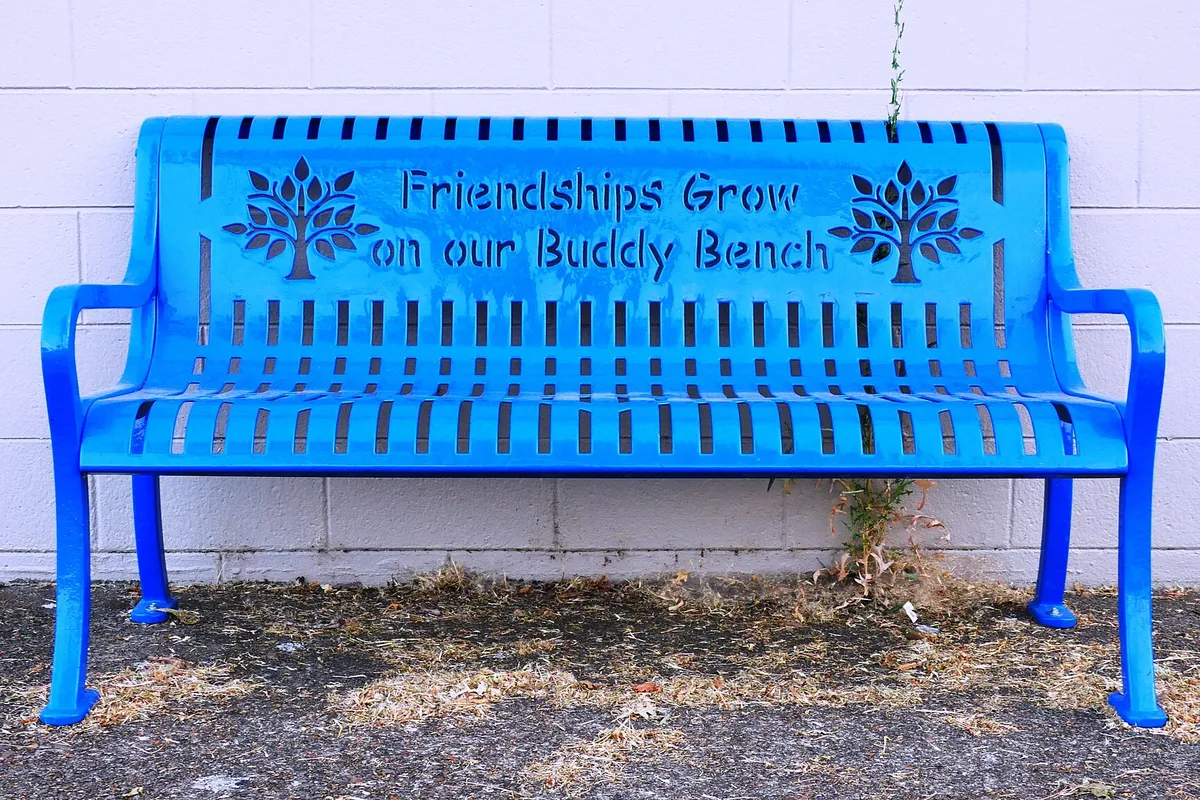
At Josh’s school, there was a blue bench by the playground gate. On the back, in curly letters, it said BUDDY BENCH. Mrs Ellis had explained it in assembly: if you had nobody to play with, you could sit on the bench, and someone would come and ask you to join in.
Most days, nobody sat on it. Josh hardly noticed it at all.
Then a new girl called Sami joined Josh’s class. She had moved from a city far away, and she had a rucksack with a fox on it. She didn’t know anyone. In class she was quiet, and at lunch she sat at the end of the table and ate her sandwich in tiny bites.
On her first playtime, Josh was playing football with his friends. He saw Sami standing by the wall, watching. On her second playtime, she was standing by the wall again.
On her third playtime, Josh looked over, and Sami was sitting on the Buddy Bench.
Josh looked at the bench, and Josh looked at the ball.
His friends were shouting. “Josh! Pass it! Come ON!” It was the best game they’d had all week. If he stopped now, they might lose.
But Sami was looking at her shoes, and her fox rucksack was on her knees, and she looked like the loneliest person in the whole playground.
Josh remembered his first day at swimming lessons, when everyone else already knew each other. He remembered how his tummy had felt, tight and fluttery, until a boy called Arjun had splashed him and said, “Race you to the side.”
Josh looked at the bench, and Josh looked at the ball.
He kicked the ball back to his friends. Then he walked over to the bench.
“Hi,” he said. “Do you like football?”
Sami shook her head. “I’m not very good at it.”
“What do you like, then?”
Sami thought. “Hopscotch,” she said. “And drawing. And foxes.”
Josh didn’t know how to play hopscotch. But there was a piece of chalk in his pocket from art. So he gave it to Sami, and she drew a hopscotch on the playground, with a fox at the top instead of a number ten. Then she showed him how to play.
Josh was terrible at hopscotch. He wobbled and fell over and landed on the fox. Sami laughed so much she had to sit down. Then two girls from Year 3 came over and asked if they could have a go. Then Arjun came over too, and asked what was so funny.
By the end of playtime, there were seven children playing on Sami’s hopscotch, and nobody at all on the Buddy Bench.
As they lined up to go in, Sami tapped Josh on the arm. “Tomorrow,” she said, “will you teach me football?”
“Yes,” said Josh. “But I’m warning you. I’m much better at football than hopscotch.”
Join in: Stop when Josh sees Sami on the bench and ask: “What do you think Josh should do?”
- Why was it hard for Josh to leave the football game?
- What did Josh remember that helped him decide?
- What could you say to someone who has nobody to play with?
Mr Okoro’s Garden
Next door to Ellie and her brother Max lived Mr Okoro. He was very old and very tall, and he always wore a flat cap, even indoors. For as long as Ellie could remember, his front garden had been the prettiest in the street, full of roses, sweet peas and big orange marigolds.
But this summer, the garden looked different. The grass was long. Weeds had grown up between the roses. The marigolds were hiding under a tangle of brambles.
“Why doesn’t Mr Okoro look after his garden any more?” asked Max.
“He hurt his hip in the spring,” said Mum. “It’s hard for him to bend down now. And I think he’s been a bit lonely since his wife died.”
That evening, Ellie looked out of her bedroom window. Mr Okoro was standing at his front window, looking at his messy garden. He looked very sad.
Ellie had an idea.
On Saturday morning, Ellie, Max and Mum knocked on Mr Okoro’s door. Ellie was holding a pair of gardening gloves. Max was holding a watering can.
“We’ve come to help with your garden,” said Ellie. “If that’s all right.”
Mr Okoro looked surprised. Then his face crinkled into a smile. “Well,” he said. “I suppose I’d better be the boss.”
Pull a weed, and plant a seed. A little help is all you need.
Mr Okoro sat on a kitchen chair on the path and told them what to do. Mum pulled out the brambles, very carefully, with her thick gloves on. Ellie pulled the weeds from between the roses. Max watered everything, including his own feet.
“Not that one!” called Mr Okoro, as Ellie reached for a feathery green plant. “That’s a carrot.”
Pull a weed, and plant a seed. A little help is all you need.
While they worked, Mr Okoro told them stories. He told them how he grew up in Nigeria, where his mother grew tomatoes and peppers outside the kitchen door. He told them how he came to England on a big ship when he was nineteen, and how he planted his first rose in this garden fifty years ago, on the day his daughter was born.
“That one,” he said, pointing to a big pink rose by the gate. “It’s older than your mum.”
By lunchtime, the garden looked like a garden again. The grass was cut. The roses could breathe. The orange marigolds were peeping out, bright as little suns.
Mr Okoro went inside and came back with a plate of biscuits and four glasses of lemonade. Then he gave Ellie and Max a small paper packet each.
“Sunflower seeds,” he said. “From last year’s flowers. Plant them in your garden, and you’ll have a bit of mine.”
After that, Ellie and Max went round every Saturday morning. Sometimes they weeded. Sometimes they watered. Sometimes they just sat on the step and listened to Mr Okoro’s stories.
And in August, over the fence between the two gardens, two tall sunflowers grew side by side, nodding at each other like old friends.
Join in: Count the jobs the children do in the garden. Can your child think of a job they could do for someone next door?
- Why had Mr Okoro’s garden become messy?
- What did Mr Okoro give the children, apart from the seeds?
- Is there someone near you who might like some help, or some company?
The Scarf That Went All the Way Round
Nana Rose had knitted Amara a scarf. It was very long and very stripy, red and yellow and green and blue, with a little pom-pom on each end. Amara loved it so much she wore it in bed.
One freezing morning, on the way to school, Amara saw a boy at the bus stop. He was shivering. He had no hat and no gloves, and his neck was bare and pink with cold.
Amara thought about her scarf. She thought about how much she loved it. Then she thought about how cold the boy looked.
She unwound her scarf and held it out. “You can have it,” she said. “My nana can knit another one.”
Round and round, from hand to hand, the kindness travelled through the land.
The boy, whose name was Theo, wore the scarf all day. On the way home, he passed the park, where an old man was sitting on a bench feeding the pigeons. The old man was coughing, and he had his collar turned up against the wind.
Theo was nearly home, and his house was warm. So he wrapped the scarf round the old man’s neck. “Someone gave it to me,” he said. “Now it’s your turn.”
Round and round, from hand to hand, the kindness travelled through the land.
The old man wore the scarf to the café, where he had a cup of tea. The waitress, Priya, had just finished a long, long shift. She was walking home in the dark, and it had started to snow.
“Here,” said the old man, and he gave her the scarf. “You’ve been on your feet all day. This will keep you warm.”
Round and round, from hand to hand, the kindness travelled through the land.
Priya wore the scarf all the way home. Outside her flat, she found a little dog tied to a lamp post, waiting for its owner, who was in the corner shop. The dog was shivering in the snow. Priya tucked the scarf around it, like a blanket.
The dog’s owner came out of the shop. She was very old, and she walked slowly, with a stick. When she saw the scarf, she stopped.
“Well, I never,” she said. “I would know those stripes anywhere.”
It was Nana Rose.
The next day, Nana Rose came to Amara’s house with the scarf over her arm. “I hear,” she said, “that this scarf has had a very busy day.”
Amara went red. “I’m sorry, Nana. I gave it away.”
“Don’t be sorry,” said Nana Rose. “It kept a boy warm, and a grandad, and a waitress, and my own little dog. That’s the best thing a scarf could ever do.”
Then she opened her bag and took out her knitting needles and a big ball of wool.
“Now,” she said. “How about you help me knit a few more? I have a feeling they’ll be needed.”
That winter, Amara and Nana Rose knitted eleven stripy scarves. And every single one went round and round, from hand to hand, all the way across town.
Join in: Keep track of who has the scarf. Before each new person, ask: “Who do you think will get it next?”
- Who had the scarf, in order? Can you remember all five?
- How do you think Theo felt when Amara gave him the scarf?
- Has someone been kind to you, so that you wanted to be kind to someone else?
The Kindness Button Jar
In Class 3, there was a big glass jar on Miss Shah’s desk. Every time Miss Shah saw someone being kind, she dropped a button into it. When the jar was full, the whole class would get a party.
Everyone wanted to fill the jar. Mia held the door open for Miss Shah, very slowly, so she would see. Plink went a button. Oscar helped Miss Shah carry the books, saying “I’m being KIND” quite loudly. Plink went another button.
But Leo never got any buttons.
Leo was quiet. He sat at the back. He never put his hand up, and he never said “I’m being kind”. Some of the class thought Leo didn’t care about the jar at all.
“Leo’s not very kind,” said Oscar at lunch. “He’s never got a single button.”
Mia wasn’t so sure. She decided to watch Leo, just for one day.
Plink, plink, into the jar. Kindness counts, wherever you are.
In the morning, Mia saw Leo pick up a pencil case that had fallen behind the radiator. He put it back on Ruby’s desk without saying anything. Ruby never knew.
At break, Mia saw Leo give half of his apple to Tomasz, who had forgotten his snack. He did it quickly, behind the climbing frame, so nobody would make a fuss.
Plink, plink, into the jar. Kindness counts, wherever you are.
At lunch, Mia saw Leo sit next to Freddie, who had been crying because his hamster had died. Leo didn’t say much. He just sat there, and let Freddie talk, and nodded.
In the afternoon, Mia saw Leo stay behind to tidy the paint pots that someone else had left out. Miss Shah had already gone to the staffroom. Nobody saw. Nobody except Mia.
Plink, plink, into the jar. Kindness counts, wherever you are.
At home time, Mia went up to Miss Shah’s desk. “Miss Shah,” she said, “I think we’ve been doing the jar wrong.”
She told Miss Shah everything she had seen. Miss Shah listened carefully. Then she was quiet for a moment.
“You’re right, Mia,” she said. “The best kindness is often the kind nobody sees. I’ve only been counting the kindness that happens in front of me.”
The next morning, Miss Shah changed the rules. Now, anyone could put a button in the jar, but only for someone else’s kindness, not their own. You had to notice it and say what you saw.
That week, the jar filled up faster than ever. Ruby put in a button for Leo. So did Tomasz. So did Freddie, with a big smile. And Leo, who had never had a single button, went bright pink and stared at his shoes, and was secretly very pleased.
Oscar put one in for Leo too. “Sorry,” he said. “I didn’t know.”
“That’s OK,” said Leo. And then, very quietly, he put a button in the jar for Oscar, for saying sorry.
Join in: At the end, ask your child to think of one quiet kindness they did today that nobody noticed. Add an imaginary button to your own jar.
- Why didn’t Leo get any buttons at first?
- What did Mia notice when she watched Leo?
- Why do you think Miss Shah’s new rule worked better?
Finn and the Mean Little Voice
Finn got seven out of ten in his spelling test. He had spelled because wrong, and friend wrong, and Wednesday very, very wrong.
As soon as he saw the crosses, a little voice started up inside his head.
You’re rubbish at spelling, said the voice. Everyone else got ten. You always get things wrong.
Everyone else hadn’t got ten. Lots of people had got six or seven. But the voice didn’t care about that.
At football after school, Finn missed a goal. You’re useless, said the voice. At dinner, he spilled his juice. Clumsy, said the voice. You’re so clumsy.
By bedtime, Finn felt heavy and grey inside, like a rain cloud.
Mum sat on the end of his bed. “You’ve been quiet tonight,” she said. “What’s up?”
Finn told her about the spelling test, and the goal, and the juice. And then he told her about the voice.
Mum nodded slowly. “I have a voice like that too,” she said. “Most people do. It thinks it’s helping, but it isn’t very kind.”
“How do you make it stop?” asked Finn.
“I’m not sure you can make it stop completely,” said Mum. “But you can answer it back. Let’s try something. Imagine your best friend Kai got seven out of ten in his spelling test. What would you say to him?”
Finn thought about it. “I’d say seven is good. And Wednesday is a really silly word, so it’s not his fault.”
Mum laughed. “What if Kai missed a goal?”
“I’d say everyone misses sometimes. Even footballers on the telly.”
“And if he spilled his juice?”
“I’d say it’s only juice,” said Finn. “And I’d help him mop it up.”
“So,” said Mum, “why don’t you say those things to yourself?”
Finn had never thought of that. It seemed strange, being kind to yourself. But he closed his eyes and tried.
It’s OK. Everyone makes mistakes. I’m still learning.
The heavy, grey feeling got a little bit lighter.
The next day, Finn got a maths question wrong. The mean little voice started up straight away. You always…
But this time, Finn answered it back, the way he would talk to Kai.
It’s OK. Everyone makes mistakes. I’m still learning.
Then he rubbed out his answer and tried again. And this time, he got it right.
That week, Finn practised his spellings every evening. On Friday he got nine out of ten. He still spelled Wednesday wrong.
But that was OK. He was still learning.
Join in: When Finn talks to himself like a friend, say the kind words together. Afterwards, ask: “What would you say to a friend who made a mistake?”
- What did the mean little voice say to Finn?
- How did Mum help Finn answer the voice back?
- What kind words could you say to yourself when something goes wrong?
How long each story takes, so you can plan around circle time or bedtime:
Bar length is out of 700 words. Read-aloud times at about 120 words a minute.
Why kindness stories matter: what the research says
Children don’t have to be taught to care about others from scratch. In a well-known experiment published in Science in 2006, psychologists Felix Warneken and Michael Tomasello showed that most 18-month-old toddlers helped an adult who dropped a peg or couldn’t open a cupboard, without being asked and without any reward. Stories build on that instinct by showing children what kindness looks like in situations they haven’t met yet.
In a 2012 study in PLOS ONE, 9- to 11-year-olds in 19 Vancouver classrooms were asked to do three acts of kindness a week for four weeks. Compared with children asked to visit three places a week, they became significantly more accepted by their classmates.
The acts in that study were ordinary: sharing lunch, helping carry the shopping, giving a sad friend a hug. That’s the kind of kindness the stories on this page are about. A few ways to make kindness part of everyday life:
- Notice it out loud. “I saw you let your brother go first. That was kind.” Being specific tells children exactly what you value.
- Talk about feelings in stories. “How do you think Sami felt on the bench?” Imagining someone else’s feelings is the root of kindness.
- Kind, not just nice. Explain that kindness sometimes takes courage, like Josh leaving his game, or telling an adult when someone is being picked on.
- Skip the rewards. Like Miss Shah’s jar, rewards can turn kindness into a performance. Noticing and thanking usually works better.
- Let consequences teach. When a child is unkind, help them put it right, which our guide to natural versus logical consequences explains.
24 simple acts of kindness for kids
Small, everyday ideas that children can actually do, with a little help from a grown-up for the younger ones:
- Make someone a cup of tea (with help)
- Lay the table without being asked
- Draw a picture for a grandparent
- Let a sibling choose the film
- Tidy up a mess you didn’t make
- Leave a kind note under someone’s pillow
- Ask someone new to play
- Share your colouring pens
- Say thank you to the dinner staff
- Help someone who drops their things
- Tell a friend what they’re good at
- Sit with someone on their own
- Wave or say hello to an older neighbour
- Pick up litter in the park (with gloves)
- Donate toys you’ve grown out of
- Put a book in a little street library
- Make a bird feeder for winter
- Help carry shopping bags
- Say one kind thing to yourself each night
- Have a rest when you’re tired
- Forgive yourself for a mistake
- Do something you love for ten minutes
- Ask for a hug when you need one
- Tell someone how you feel
A 7-day kindness challenge for kids
Try one a day for a week. It works at home or as a class challenge, and it’s a good way to mark World Kindness Day (13 November) or Anti-Bullying Week, which schools hold every November.
| Day | Kindness challenge | Done |
|---|---|---|
| Monday | Smile and say good morning to three people. | ☐ |
| Tuesday | Help at home without being asked. | ☐ |
| Wednesday | Give someone a compliment about something they did, not how they look. | ☐ |
| Thursday | Include someone who is on their own. | ☐ |
| Friday | Write a thank-you note to a teacher, coach or neighbour. | ☐ |
| Saturday | Do something kind for the planet: litter pick, feed the birds, or plant a seed. | ☐ |
| Sunday | Be kind to yourself. Say three things you did well this week. | ☐ |
At the end of the week, talk about which day was hardest and which made them feel best. Children often say the last one, being kind to themselves, was the trickiest.
9 books about kindness for kids
All of these are easy to find in UK libraries and bookshops. The first seven are picture books; the last two are chapter books for reading aloud to older children.
More stories and ideas from Kids Magazines
- More original stories to read together: stories for 4-year-olds and stories for 7-year-olds (try “Bolt the Robot Can’t Say Sorry”).
- Short on time? Our 5 minute bedtime stories.
- Helping a sensitive child with big feelings: deeply feeling kids.
- What to do when kindness goes wrong: natural versus logical consequences.
Stories about kindness: your questions answered
What is a good story about kindness for kids?
A good kindness story shows a character choosing to be kind when it isn’t easy, and lets children see how it changes things for someone else. On this page, “The Bench by the Gate” is about including someone new, “The Scarf That Went All the Way Round” shows kindness being passed on, and “Finn and the Mean Little Voice” is about being kind to yourself. Published favourites include The Smartest Giant in Town and Kindness Grows.
How do you teach kindness to a child?
Children learn kindness mostly by watching what adults do, so modelling matters most. Notice and name kindness when you see it (“That was kind, you shared without being asked”), talk about how characters in stories feel, and give children real chances to help, such as making a card or helping a neighbour. Praise the kind act itself rather than offering rewards.
At what age do children understand kindness?
Children start helping others surprisingly early. In a 2006 study published in Science, Felix Warneken and Michael Tomasello found that most 18-month-old toddlers helped an adult who was struggling to reach something, without being asked or rewarded. Understanding why kindness matters, and seeing things from someone else’s point of view, keeps developing through the primary school years.
What are some simple acts of kindness for kids?
Simple acts of kindness for children include asking someone new to play, sharing, saying thank you to school staff, helping at home without being asked, writing a thank-you note, donating toys they’ve grown out of and feeding the birds in winter. The ideas list on this page has 24, grouped by home, school, community and being kind to yourself.
Does being kind really help children?
There is good evidence that it does. In a study published in PLOS ONE in 2012, researchers led by Kristin Layous asked 9- to 11-year-olds in Vancouver to do three acts of kindness a week for four weeks. Those children became more accepted by their classmates than a comparison group who visited three places a week instead.
Is kindness taught in UK schools?
Yes. In England, Relationships Education has been compulsory in all primary schools since 2020. It covers caring friendships, respectful relationships and how to treat others. Many schools also mark World Kindness Day on 13 November and Anti-Bullying Week, which takes place every November.
How can I help my child be kind to themselves?
Notice when your child is harsh on themselves and gently ask what they would say to a friend in the same situation, as Finn’s mum does in the story above. Talk about your own mistakes calmly, so they see that getting things wrong is part of learning. If your child often feels overwhelmed by big emotions, our guide to deeply feeling kids may help.
Sources: Warneken F. & Tomasello M. (2006), “Altruistic helping in human infants and young chimpanzees”, Science 311(5765); Layous K. et al. (2012), “Kindness Counts: Prompting Prosocial Behavior in Preadolescents Boosts Peer Acceptance and Well-Being”, PLOS ONE 7(12); Department for Education: Relationships Education, Relationships and Sex Education and Health Education statutory guidance; Anti-Bullying Alliance: Anti-Bullying Week. Stories © Kids Magazines. Featured photo: Shixart1985, Wikimedia Commons, CC BY 2.0.