Stories for 7-year-olds need a proper plot, a bit of mystery or mischief, and a twist that makes them laugh. Here are five original stories written for Year 2 and Year 3, free to read. Two are short enough for a newly confident reader to finish alone. Three are told in short chapters, with the flavour of a first chapter book, and are best read aloud or shared over two nights.
You’ll find a lunchbox mystery, a robot who can’t apologise, a tiny dragon who eats full stops, a 1968 treasure map, and a boy who is sure his teacher is a werewolf. Each story has a way to join in and questions to talk about afterwards. Further down: how to share reading at seven, what reading looks like in Year 2 and Year 3, and nine chapter books to try next.
The short answer
- To read alone: Bolt the Robot Can’t Say Sorry and My Teacher Is Definitely a Werewolf (about 450 words each, 5 minutes for a fluent reader).
- To read aloud, in chapters: The Great Lunchbox Mystery, The Dragon Who Ate Full Stops and Grandad’s Treasure Map.
- What works at seven: 5–10 minutes aloud, a mystery or mission, humour, a twist, and short chapters that end with a reason to keep going.
Story finder: stories for 7-year-olds at a glance
Choose by mood, or by whether your child wants to read it themselves. Read-aloud times assume about 120 words a minute.
| Story | Read aloud | Read alone* | Words | What it’s about | Best for |
|---|---|---|---|---|---|
| 1. The Great Lunchbox Mystery | 4 min | 5 min | 489 | Mystery · clues · not jumping to conclusions | Young detectives |
| 2. Bolt the Robot Can’t Say Sorry | 4 min | 5 min | 444 | Robots · real apologies · brothers and sisters | After a falling-out |
| 3. The Dragon Who Ate Full Stops | 5 min | 6 min | 575 | Dragons · libraries · punctuation, secretly | Children learning full stops |
| 4. Grandad’s Treasure Map | 5 min | 7 min | 627 | Treasure hunt · family history · the local park | Adventurous children |
| 5. My Teacher Is Definitely a Werewolf | 4 min | 5 min | 459 | Funny · school · getting the wrong idea | Reluctant readers who love a laugh |
*Reading-alone times assume about 90 words a minute, the fluency marker in the DfE Reading Framework. Many seven-year-olds will be slower, and that’s fine.
5 original stories for 7-year-olds
Chapter headings are in red. The chapter stories make a natural stopping point if you want to spread them over two nights, and stopping on a cliffhanger is a good way to get a child asking for more.
The Great Lunchbox Mystery
Chapter 1: The Missing Biscuit
On Monday, Kofi opened his lunchbox and counted. Sandwich. Apple. Cheese stick. And… no biscuit.
“Mum always gives me a custard cream,” he told his best friend Ruby. “Always.”
“Maybe she forgot,” said Ruby.
But on Tuesday, it happened again. And on Wednesday. And this time, there was a tiny hole nibbled in the corner of the lunchbox lid.
“Someone,” said Kofi darkly, “is stealing my biscuits.”
Ruby narrowed her eyes. “I bet it’s Big Danny from Year 4. He hangs his coat right next to yours. And he LOVES biscuits.”
Chapter 2: The Clues
Kofi wanted to march straight up to Big Danny. But Grandma always said, “Find the facts before you point the finger.” So he got out a notebook and wrote CLUES at the top.
Clue 1: The biscuit goes missing in the morning, while the lunchboxes are in the cloakroom.
Clue 2: There is a tiny hole in the lid. Too tiny for a person.
Clue 3: There are crumbs on the floor under the bench.
“Danny’s got big hands,” said Kofi slowly. “He couldn’t make a hole that small.”
Ruby frowned. “Then who could?”
They needed a trap. With their teacher Mrs Patel’s permission, they borrowed a little bag of flour from the school kitchen. At home time on Wednesday, they sprinkled a thin, white layer all over the cloakroom floor.
Chapter 3: The Culprit
On Thursday morning, Kofi and Ruby were first through the door.
The flour was covered in footprints. Not big trainer prints. Tiny prints, like little stars, with a thin wiggly line between them.
“That line,” whispered Ruby, “is a tail.”
The footprints led under the bench, behind the lost property box, to a small gap in the skirting board. Kofi lay on his tummy and shone Mrs Patel’s torch inside.
Two shiny black eyes looked back at him. Then two more. Then four more.
It was a mouse, curled up in a nest made of shredded paper towels and one very old sock. Snuggled around her were three tiny babies. And right in the middle of the nest was half a custard cream.
“She’s not a thief,” said Kofi. “She’s a mum. She’s feeding her family.”
Mr Bell the caretaker came with a special box that doesn’t hurt mice. Very gently, he moved the mouse family to the shed at the end of the school garden, with a pile of straw and a few crumbs to start them off.
At lunchtime, Kofi’s custard cream was safe. He looked across at Big Danny, who was eating a plain apple and looking a bit glum.
Kofi thought about how close he’d come to blaming him. Then he snapped his biscuit in half.
“Want some?” he said.
Danny grinned. “Thanks! What’s that white stuff on your jumper?”
“Flour,” said Kofi. “It’s a long story.”
Join in: Stop at the end of Chapter 2 and ask: “Who do you think the thief is? What clues do you have?” Write the guesses down and check them at the end.
- What were Kofi’s three clues? Which one proved it wasn’t Danny?
- Why did Grandma say “find the facts before you point the finger”?
- Has anyone ever blamed you for something you didn’t do? How did it feel?
Bolt the Robot Can’t Say Sorry
Amara built Bolt out of a robot kit she got for her seventh birthday. He had wheels instead of feet, a square head with two blue lights for eyes, and a speaker for a mouth. She programmed him to say “Hello”, “Goodbye” and “Please may I have a biscuit?”
On Saturday morning, Bolt went for a drive round the living room. He went past the sofa. He went past the cat. Then he crashed straight into the giant Lego tower that Amara’s little brother Femi had spent all week building.
CRASH! Bricks flew everywhere.
“My TOWER!” wailed Femi.
Bolt’s blue lights flashed. “BEEP. ERROR. NOT MY FAULT,” he said.
“Bolt!” said Amara. “You have to say sorry!”
So she plugged him into her tablet and typed in a new word. She pressed the button.
“SORRY,” said Bolt, in a flat, beepy voice. Then he turned round and drove into the cat.
Femi folded his arms. “That’s not a real sorry,” he said. “He doesn’t even mean it.”
Amara thought about it. Femi was right. Just saying the word wasn’t enough. So what made a sorry real?
She remembered what Dad said when he burnt her toast last week. “I’m sorry I burnt your toast. I know you were hungry. I’ll make you a new piece.” And he had, with extra butter.
“A real sorry has three parts,” said Amara slowly. “One: say what you did. Two: say how the other person feels. Three: try to put it right.”
She typed for a long time. Then she pressed the button.
Bolt rolled up to Femi. His lights glowed a soft blue. “I AM SORRY I KNOCKED DOWN YOUR TOWER,” he said. “YOU MUST FEEL CROSS AND SAD. I WILL HELP YOU BUILD IT AGAIN.”
Femi giggled. “Robots can’t build Lego.”
“He can carry the bricks,” said Amara, and she put a tray on Bolt’s back.
So Bolt drove back and forth, carrying bricks, and Femi and Amara built the tower again. It was even taller this time, with a lookout at the top.
When it was finished, Amara felt a funny, wriggly feeling in her tummy. She remembered something. Last week, she had borrowed Femi’s best felt-tips, and she had left the lids off, and they had dried up. She had never said sorry. Not properly.
“Femi,” she said. “I’m sorry I ruined your felt-tips. That was unfair, and you must have been upset. I’ll buy you new ones with my pocket money.”
Femi looked at her. Then he gave her a hug.
“BEEP,” said Bolt. “PLEASE MAY I HAVE A BISCUIT?”
Join in: Take turns doing Bolt’s robot voice. Afterwards, practise the three parts of a real sorry together.
- Why wasn’t Bolt’s first “SORRY” a real sorry?
- What are the three parts of a real sorry?
- Why did Amara get a wriggly feeling in her tummy at the end?
The Dragon Who Ate Full Stops
Chapter 1: Something Strange in the Library
Every Tuesday after school, Isla went to the town library with her dad. She always went straight to the same shelf and took out the same book: The Princess and the Goat.
But this Tuesday, when she opened it, something was very wrong.
“Once upon a time there was a princess she lived in a castle she had a pet goat called Gary Gary ate the curtains the king was cross the queen was cross even the cook was cross and Gary did not care at all”
Isla gasped. She had read it all in one breath, and she was dizzy.
“Dad,” she said. “All the full stops have gone.”
She checked another book. No full stops. And another. Not a single one. Every sentence just ran on and on into the next one like a runaway train.
Then she noticed something on the floor. A tiny trail of black dots, like spilled pepper, leading behind the poetry shelf.
Chapter 2: A Very Small Dragon
Isla crept round the shelf. There, sitting on a dusty copy of Nursery Rhymes, was a dragon.
It was no bigger than a pencil case. It had green scales, a curly tail, and a very round tummy. It was licking a page, and as Isla watched, the last full stop on the page vanished with a tiny crunch.
“Excuse me,” said Isla. “Are you eating the full stops?”
The dragon jumped. Then it hiccuped, and a puff of smoke came out. “They’re crunchy,” it said in a small, guilty voice. “Like peppercorns. My name is Speck. I got lost and I was SO hungry.”
“But without full stops, nobody can read the books properly,” said Isla. “Full stops tell you when to stop and take a breath. They show where one idea ends and the next one starts.”
Speck looked at his round tummy. “Oh,” he said. “I didn’t know they had a job.”
Chapter 3: A Feast of Full Stops
Mr Hughes the librarian could hardly believe it, but there was no time to argue. “Can you put them back?” he asked.
Speck thought. “If I know where they go, I can breathe them out again. But I don’t know where sentences end.”
“I do,” said Isla. “You can hear it, when you read out loud. Your voice stops at the end of a sentence. Listen.”
So Isla opened The Princess and the Goat and read it out loud, slowly. Every time her voice stopped, Speck breathed out a tiny puff, pop, and a full stop landed in exactly the right place.
“Once upon a time there was a princess.” Pop. “She lived in a castle.” Pop. “She had a pet goat called Gary.” Pop.
They read book after book, until Isla’s voice was croaky and every full stop in the library was home.
“But what will Speck eat now?” asked Isla.
Mr Hughes smiled. He opened his desk drawer and took out the hole punch. He tipped it upside down, and out poured hundreds of little paper circles.
Speck crunched one. His eyes went wide. “Even better than full stops,” he said. “They’re bigger.”
Now Speck lives in Mr Hughes’s desk drawer. Every time somebody punches holes in paper, he gets his dinner. And every Tuesday, Isla comes to read to him, out loud, with all the full stops in.
Just in case.
Join in: Read the run-on sentence in Chapter 1 in one breath, without stopping, and see who runs out of air first. Then read it again with full stops.
- Why was the book so hard to read without full stops?
- How did Isla know where the full stops should go?
- Can you find three full stops on this page? What would happen without them?
Grandad’s Treasure Map
Chapter 1: The Box in the Attic
When Grandad moved into his new bungalow, Jas and Theo helped Mum clear out his old attic. It was full of dusty suitcases, rolled-up rugs, and a lampshade shaped like a pineapple.
At the very back, under a pile of comics, Theo found a biscuit tin. Inside was a piece of paper, folded into four, and soft as cloth.
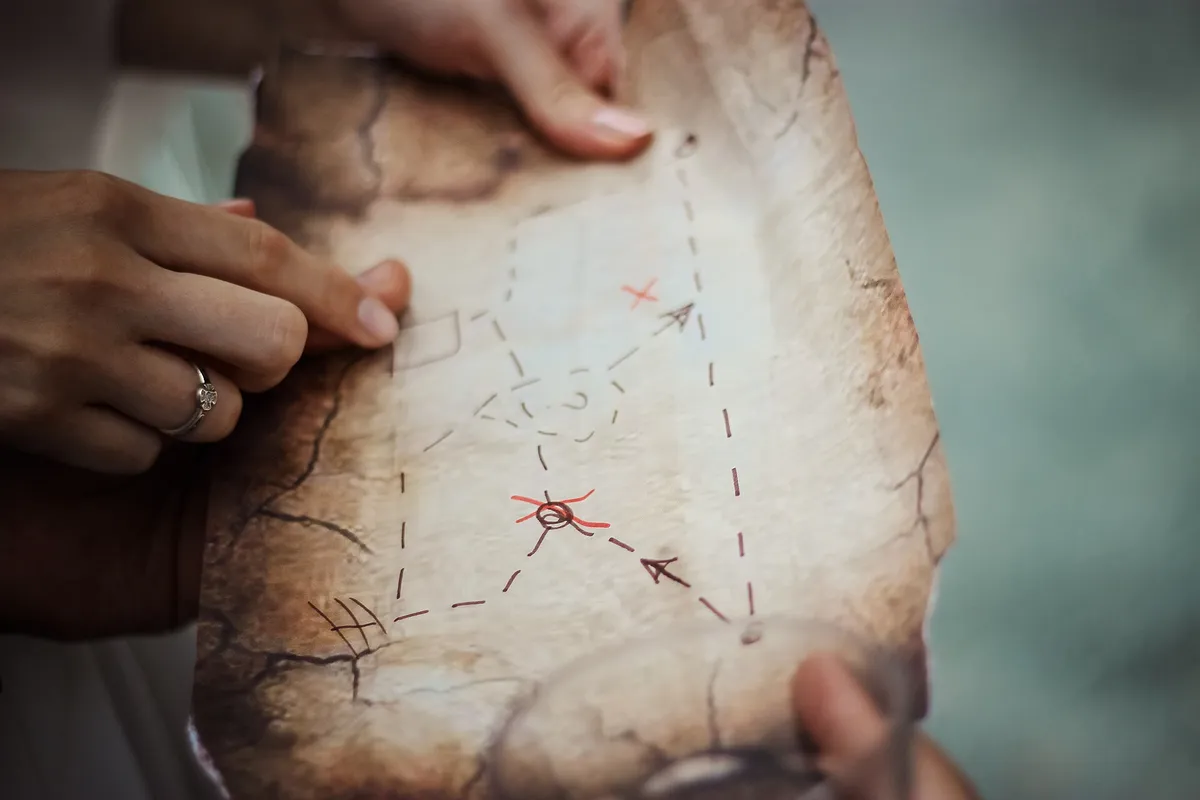
Jas unfolded it carefully. It was a map, drawn in pencil and crayon. At the top, in wobbly capitals, it said:
SECRET TREASURE MAP. BY ARTHUR, AGED 8. 1968. TOP SECRET!!!
“Arthur,” said Theo. “That’s Grandad!”
Under the title were three clues:
1. Start at the red post box on Mill Lane.
2. Walk 50 big steps to the bandstand in the park.
3. Find the oak tree with the face. The treasure is buried at its feet. X marks the spot!
They rang Grandad straight away. There was a long pause on the phone. Then Grandad laughed so loudly that Mum had to hold the phone away from her ear.
“I’d forgotten all about that,” he said. “I wonder if it’s still there. Pick me up tomorrow. I’m coming too.”
Chapter 2: Following the Clues
On Saturday, Grandad came with his walking stick, his flat cap and a small garden trowel in his coat pocket.
The red post box was still on Mill Lane. “Post boxes last for ever,” said Grandad, patting it. “This one is older than me.”
“Clue two,” said Jas. “Fifty big steps to the bandstand.”
They took fifty big steps. They ended up in the middle of a car park.
“Hmm,” said Grandad. “My legs were shorter in 1968.”
Theo had an idea. “Grandad’s steps were little-boy steps. So we should take little steps, like an eight-year-old.” Theo was eight. He took fifty steps of his own, and Jas counted out loud.
…forty-eight, forty-nine, fifty! They were standing at the park gate, and right in front of them was the old green bandstand, with its pointy roof.
“Clue three,” whispered Jas. “The oak tree with the face.”
There were lots of trees in the park. They looked at every single one. Then Theo grabbed Jas’s arm. On the far side of the pond stood a huge old oak. On its trunk, two knots looked like eyes, and a long crack underneath looked just like a smiling mouth.
Chapter 3: X Marks the Spot
Before they dug, Mum asked the park warden if it was all right. The warden listened to the whole story, then said, “Go on, then. I want to see this.”
Grandad pointed his stick at a spot between two big roots. “There,” he said. “I remember now.”
Jas and Theo took turns with the trowel. The soil was hard and full of stones. They dug down, and down, until… CLINK.
It was a small tin, rusty at the edges. Grandad’s hands shook a little as he opened it.
Inside were four glass marbles, a toy car with one wheel missing, a badge that said WORLD CUP 1966, and a note in the same wobbly writing as the map:
To whoever finds this. Well done! You are the best explorer in the world. From Arthur.
Grandad was very quiet for a moment. Then he said, “I suppose that means you two.”
That night, Jas and Theo made a new note, and found some things of their own to go in the tin: a shiny pound coin, a photo of all three of them by the oak tree, and Theo’s second-best football card.
The next day, they buried the tin again, at the feet of the oak tree with the face.
“For the next explorer,” said Grandad.
Join in: Before Chapter 2, draw your own map of the route Jas and Theo take: post box, bandstand, oak tree. Add an X where you think the treasure is.
- Why did they end up in a car park the first time?
- What was in Grandad’s tin? Which thing would you most like to find?
- If you buried a tin for someone in the future, what would you put in it?
My Teacher Is Definitely a Werewolf
My name is Max, I am seven and three-quarters, and I have worked out a terrible secret. My teacher, Miss Hartley, is a werewolf.
At first I wasn’t sure. But then I started collecting evidence, like a real detective.
Evidence number one: Miss Hartley always wears big, hairy, woolly jumpers. Even when it’s warm. What is she hiding under there? FUR, probably.
Evidence number two: In assembly, when we sing, Miss Hartley sings very loudly and very high. My friend Leila says it’s called opera. I say it sounds exactly like howling.
Evidence number three: Every Monday morning, Miss Hartley looks really, really tired. She has a big mug of coffee and yawns all through phonics. What has she been doing all night? Running through the woods, that’s what.
Evidence number four: She has a LOT of ham sandwiches for lunch.
Leila was not convinced. “Lots of people eat ham sandwiches,” she said. “My dad eats ham sandwiches.”
“Then maybe your dad is a werewolf too,” I said. Leila didn’t talk to me for the rest of playtime.
Then I found the final piece of evidence. On the classroom calendar, Miss Hartley had written PARENTS’ EVENING on Thursday. And on the calendar in our kitchen, Thursday had a little round picture on it. A full moon.
Parents’ evening. Full moon. At NIGHT. I felt cold all over.
On Thursday evening, I made Mum hold my hand very tightly as we walked into school. I checked Miss Hartley’s eyebrows for extra hair. I checked her teeth for fangs. She just smiled and said I was trying really hard with my handwriting.
On the way out, we walked past the car park. Miss Hartley’s car was there. And in the back seat, something moved.
Something big. Something grey. Something HAIRY.
Two yellow eyes looked at me through the window. Then a long nose pressed against the glass and went SNUFFLE.
I screamed. Mum jumped. And Miss Hartley came running out of school with her car keys.
“Oh, Max!” she laughed. “Have you met Luna?”
She opened the car door, and out bounced the biggest, scruffiest, waggiest dog I have ever seen. It licked my whole face in one go.
“She’s an Irish wolfhound,” said Miss Hartley. “She’s only a puppy, believe it or not. She howls all night when she’s lonely, so I hardly get any sleep. And her name, Luna, means moon.”
Then she brushed a big clump of grey dog hair off her woolly jumper.
So now I know the truth. Miss Hartley is not a werewolf. She is a teacher with a very big, very hairy dog.
Probably.
I’m still keeping an eye on those ham sandwiches.
Join in: Count Max’s “evidence” on your fingers as you go. Afterwards, ask: was any of it actually evidence?
- What was Max’s “evidence”? What was the real explanation for each bit?
- Why is the last word “Probably” funny?
- Have you ever been sure about something and then found out you were wrong?
How the five compare in length. The two blue bars are the ones designed for reading alone; the red ones are the chapter stories, best read aloud or over two sittings:
Bar length is out of 700 words. Read aloud at about 120 words a minute; reading alone at about 90 words a minute.
Reading together at seven: 4 ways to share a story
At seven, most children sit somewhere between listening and reading for themselves. The trick is to keep both going. These four habits help:
Mysteries like “The Great Lunchbox Mystery” are especially good at this age. Around seven, many children move into what Jean Piaget called the concrete operational stage, when they get much better at logical thinking about real things, like following clues. Our explainer on Piaget’s theory covers the stages in more detail, and our brain development activities for kids have more puzzles to try.
What reading looks like in Year 2 and Year 3
Most seven-year-olds in England are in Year 2 (the last year of key stage 1) or Year 3 (the first year of key stage 2), depending on when their birthday falls. Here’s what’s happening with reading across those two years:
9 chapter books 7-year-olds love
These are easy to find in UK libraries and bookshops. The first few have lots of pictures and short chapters, which makes them ideal first chapter books to read alone. Fantastic Mr Fox and The Bolds are brilliant read-alouds.
More stories and ideas from Kids Magazines
- For quick bedtime reads: our 5 minute bedtime stories.
- Another mystery for confident readers: The Case of the Moved Bookmark.
- Winding down at night? Our bedtime stories for 5-year-olds are calm enough for older children too.
- Reading with younger brothers or sisters? Try our stories for 3-year-olds and stories for 4-year-olds.
- More things to do after school: educational activities for kids to do at home.
Stories for 7-year-olds: your questions answered
What kind of stories do 7-year-olds like?
Seven-year-olds love stories with a bit more going on: a mystery to solve, a mission, jokes that rely on knowing more than the character does, and a twist at the end. Many are ready for short chapter books. They also like stories about school, friendship and getting things wrong, because those are big parts of their lives.
How long should a story be for a 7-year-old?
For reading aloud, 5 to 10 minutes works well, or one or two chapters of a chapter book. That’s roughly 600 to 1,200 words. For reading alone, shorter is better: 400 to 600 words is a good length for a newly confident reader to finish in one sitting. The stories on this page range from about 450 to 630 words.
Should I still read aloud to my 7-year-old?
Yes. The Department for Education’s Reading Framework stresses reading aloud to children every day, because they can understand much richer language and longer stories than they can read for themselves. Reading aloud keeps stories enjoyable while their own reading catches up.
How well should a 7-year-old read?
Children vary a lot at this age. By the end of Year 2, the national curriculum expects most children to read familiar words quickly without sounding them out and to read books matched to their phonics knowledge accurately. The Reading Framework suggests that around 90 words a minute is the speed at which children can read fluently enough to focus on what the text means. If you’re worried, talk to your child’s teacher.
When should children start reading chapter books?
Many children move on to short chapter books in Year 2 or Year 3, at around age 6 to 8. Look for books with short chapters, plenty of illustrations and large print, such as The Worst Witch or Claude in the City. Reading the first chapter aloud together often gets a child hooked enough to carry on alone.
My 7-year-old doesn’t like reading. What can I do?
Let them choose, even if it’s comics, joke books or books about football. Funny books such as Mr Gum and stories like “My Teacher Is Definitely a Werewolf” on this page are good hooks. Take turns reading pages, keep sessions short, and keep reading aloud to them so books stay fun rather than a chore.
Do 7-year-olds take SATs?
Key stage 1 tests, often called Year 2 SATs, became optional for schools in England from the 2023/24 school year, so whether your child takes them depends on their school. The phonics screening check is still statutory in Year 1, with a retake in Year 2 for children who didn’t meet the standard.
Sources: Department for Education: National curriculum in England, English programmes of study (key stages 1 and 2); Department for Education: The reading framework (2023); Standards and Testing Agency: Phonics screening check guidance; Standards and Testing Agency: Key stage 1 assessment, optional from the 2023/24 academic year. Stories © Kids Magazines. Featured photo: HonjuTheCat, Wikimedia Commons, CC0.